
The Leak Effect: How Early Disclosure Is Impacting M&A Outcomes
4 February 2026 | 2:00 - 2:45pm GMT
How are surging M&A leaks impacting deal outcomes? In this webinar, researchers from London’s Bayes Business School will unpack key findings from the 2025 M&A Deal Leaks Report.
You’ll gain data-driven insights into:
- Why leak activity is accelerating across global markets
- How leaks influence valuations, competition and timelines
- Which regions and sectors are most exposed
- Best practices for reducing disclosure risk and protecting value
Speakers:
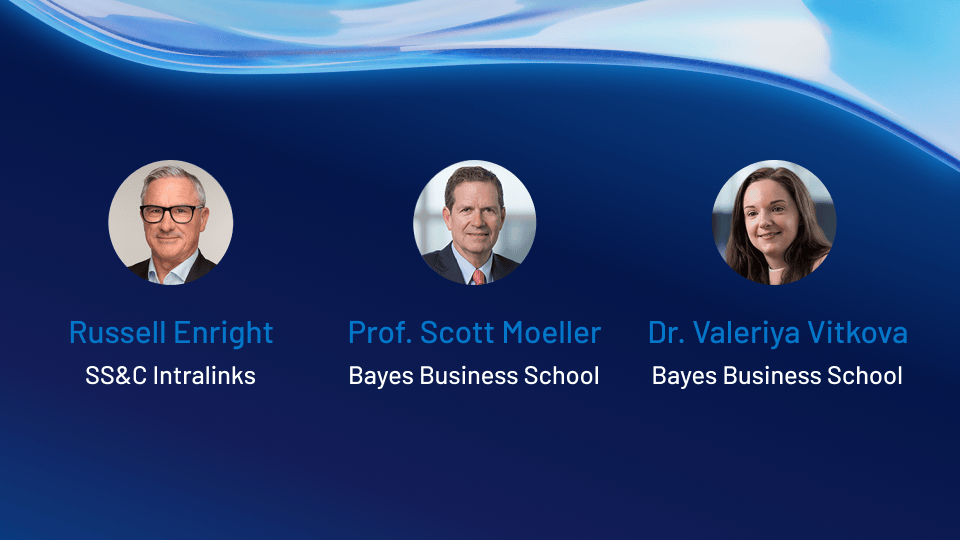
- Professor Scott Moeller, Founder, M&A Research Centre, Bayes Business School
- Dr. Valeriya Vitkova, Senior Lecturer in Corporate Finance, Bayes Business School
Moderator:
- Russell Enright, VP, SS&C Intralinks
Running time:
- 45 Minutes
Transcript
Russell Enright
00:06 - 03:14
Hello, and welcome to our webinar on the leak effect or how early disclosure is impacting m and a outcomes. My name is Russell Enright.
I'm the head of banks and corporates EMEA at SS&C Intralinks. So before we get started, let me share a few words of housekeeping with you before we get into the meat over the next forty five minutes.
Any announcements during the course of the webinar will be posted in the chat Next to the chat is the docs tab where you'll see the leaks report and other material we'll be referencing throughout the webinar. Finally, you'll see a q and a tab.
So please submit any questions you have there, and we'll try and get to them all at the end. The session is being recorded, and we'll send it out after the event.
And to make it interactive, we're gonna be launching some polls during the session. And we'd love for you all to participate in those.
So we'll prompt you when those are coming up. So I'm very happy to be joined by professor Scott Moeller, who's professor in the practice of finance and the founder of the M and A Research Center at Bayes Business School, and doctor Valeriya Vitkova, who is the assistant professor in corporate finance also at the Bayes Business School.
And at Intralinks, we're very proud to have a long standing partnership with Bayes. We're gonna actually discuss the latest findings of an annual research paper that we first did back in 2009.
And I think before we start, I'll just say a little bit about why I think this research is so critical. It's not just one of the most comprehensive reports.
It's the only comprehensive globally comparative analysis of deal leagues. Now while you might see localized country level studies, this research is unique because we apply a single consistent methodology across every jurisdiction, which allows us to provide a true apples to apples comparison of how deal behavior is shifting from New York to London to Singapore.
So since 2,009, the collaboration has allowed us to track the evolution of deal hygiene, and frankly, the 2026 data continues to surprise us. Despite tighter regulation and significant advances in deal technology, leaks are more prevalent than ever with some regions seeing double digit leak rates.
That really underscores our theme for today. Managing information flow isn't just about confidentiality.
It's about controlling the value and integrity of your transaction. So to kick things off, let's look at the data behind these shifts.
Valeriya, could you walk us through what the research reveals about global leak activity and where we're seeing the most significant changes?
Valeriya Vitkova
03:14 - 10:23
Yeah. Absolutely.
So based on our most recent report, which covers information about 2024, what we can see is global leak rates in 2024 were the highest ever. So 2024 was a year a record year for m and a leaks.
In terms of the size of that, 10% of all deals showed statistically detectable leaks. And this is the highest level since the start of our data, which we start the tracking in 2009.
So I think this is a very, very significant finding. And to give you a bit of more context, that's sharply up from 2023.
So in 2023, we saw eight percent of all deals that are announced were associated with abnormal trading. So there was evidence that there's leaking of information involved.
Whereas now, we see that in 2024, which is the latest year that we have data for, 10% of all announced deals were associated with abnormal trading, and therefore, we can conclude that there was some leakage of information. In addition, this is above our average over the time period that we're looking at.
In terms of then looking at what regions or what sectors may have contributed to this. First of all, looking at the regional contrasts, I think it's very interesting to see how we are observing a shift in terms of the trends in 2024, which potentially suggests that there is a reshaping of the map when it comes to regions that are most likely to leak.
So the APAC region saw the highest levels of deal leaks. This accounted for 12% of all announced deals, and it's compared to 9% deals that leaked the year before for that region.
The APAC also represent the highest of any region in 2024, and it's a historical peak for that region itself. So the region itself tends to be quite leaky.
Then if we wanna think about which countries contributed to that, South Korea and India rank near the top in 2024 in terms of leakiness. And these countries also tend to be among the leakiest if we consider our analysis since the data started, which is 2009.
Now focusing on some of the other regions, looking at the EMEA, the region also experienced a sharp rise with leak rates jumping to 9%, and that's up from 6% the year before. So that's a substantial jump.
In terms of countries that may have contributed to that, France stands out, and that country experienced some of the highest levels of leaking in the year that we in the latest year, which is 2024. The only caveat to that is that we have a relatively small sample for France.
So the number of public acquisitions acquisitions of public targets that were announced in France is comparatively low, and so we just need to look at this data with a bit of caution because of the sample size. Very interesting when we're looking at the regions is that The Americas, which includes one of the biggest markets globally, The US, is an outlier because, actually, leaks fell in that region.
So approximately 7% of all announced deals were associated with the leak, and that's below our long term average and below what we observed the year before in 2023. Now moving on to the sectors, what we see is that technology, media, and telecoms ranked at the top in 2024.
So this was the region associated with highest levels of leaks. Approximately 16% of all announced transactions had abnormal preannouncement trading.
The other two sectors are financials and consumer, and these also experienced elevated leak rates. And you can see that on the slide here.
For financials, it's about 12%, and consumer, about 10%. And then I think in terms of findings, it's important to highlight something else which stand out from our report.
And this is a consistent and clear finding from our study, which shows that the premiums associated with MNA transactions where we have a leak tend to be significantly higher compared to the premiums associated with deals that do not have any association with leaks. In 2024, leaked deals had a premium average premium of about 58%, whereas nonliked deals had a premium of about 26%.
Now this is a difference, which is very significant. So leaked deals experience almost double the size in terms of premium compared to nonliked deals.
And I know that Scott is going to touch on the factors that may be contributing to this difference. But these are some of the big picture findings that we see with the reports, and I'm happy to touch on some of the possible explanations when we're looking at the region or sector level, if that will help.
Scott Moeller
10:23 - 10:24
Valeriya,.
Russell Enright
10:24 - 10:24
Okay.
Scott Moeller
10:24 - 10:48
just just before we move on a little bit, there's been a question just about how we define what a leak is. I could say that, but why don't you talk about how we classify a leak because we do have to make sure we have a consistent methodology, as you mentioned, across the whole world and to be able to look at different sectors, look at different regions.
Valeriya Vitkova
10:48 - 11:45
Yeah. Absolutely.
So what we're looking at is abnormal changes in the share price of the targets. And the way that we look at this is by looking at statistically significant shifts in the stock price of target companies prior to the public announcement of acquisitions.
So we're looking at movements in the share price that are abnormal for the specific company, and we test that, with appropriate statistical methodologies to make sure that this is, robust and reliable. We typically consider the period of a month before the acquisition before the formal announcement of m and a transactions for this.
Russell Enright
11:45 - 13:35
Excellent. Thank you, Val.
Great. Let's go to a poll.
I think it's a good moment, for us to get the audience involved. Let's start with a poll about where do the leaks come from.
So where do you think leaks are most likely to originate? So we've got some choices here for you to pick on. Advisors or intermediaries, internal employees or management, investors or market participants or regulatory or media channels.
What do you think is the answer to that? So we have our answer. We see the votes coming in.
We've got probably slightly edging it is internal employees or management, I would say, is at the front, narrowly followed by investors or market participants. Let's just wait another minute until we've got all the votes in.
Okay? We locked, Jen. So I think the the consensus amongst the audience is internal employees or management, which is actually the correct answer.
So that did score highest in the poll that we did, which is, an interesting result. So I'd like to, with that in mind, turn to Scott about the drivers behind the rise in leaks.
Do we think that most leaks are accidental, or are they deliberate strategies that are employed?
Scott Moeller
13:35 - 19:42
Well, what we found, Russell, and thank you very much for inviting us to talk about this, by the way. What we found is that there's there's kind of a urban myth out there that that leaks also happen accidentally, and that's almost not true at all.
You know, there's a reason why the leak is being made, and the leak is being made specifically to achieve a certain result. That might be, one could say, in order to be able to get more bidders, although we don't find the evidence that there are more bidders on leaked deals versus nonleaked deals.
They seem to be about the same. It might be that there are those people who are upset about the deal, and that's why internal management or other employees, which was that category, was scores high and from our research scores high as well.
Or, of course, it could be part of a very deliberate strategy by the advisers, although it seems that most people think that the management will then do the leak, that that that's the way they want to manage the deal. And I can come back to that because that happens to be something that the regulators take great exception to and would prefer not to see.
I think it's interesting as well when you look at these leaks, just a couple other factors which may come into play in trying to explain what's happening. But we looked as well as to whether these deals, whether it's more likely that a deal that is leaked is going to complete or not, that is, once it's been announced, will it actually get to completion, or do deals that don't leak, you know, tend to complete more? Now, of course, we know that most announced deals do complete on that something on the order of about 80 to 85%, and the figure that we find is about 80 is 83% at least in the most recent year.
But notably, fewer than that, 78% of the leaked deals complete. So you do introduce a risk factor by having a deal that leaks, and I think that's something to keep in mind as for anybody who is looking to leak a deal, if your purpose is in fact to stop the deal from taking place, perhaps that might be a good strategy.
If the reason was something else that you think might benefit the deal in some way, you might want to consider that it's less likely, albeit not by a significant margin, than to complete and be a deal that you would be able to gain that benefit from. The other thing to take into account, think, Russell, is that leaked deals do take longer than non leaked deals.
When we look at the data on this, it's consistently within the last couple years to be about two weeks longer. And in fact, just to give you the actual figures if anybody wants it, these are in the report as well that they can download from Intralinks.
But it's a hundred and sixteen days from announcement to closing for the average deal. Now, again, as Valeriya mentioned, these are publicly listed companies, so these would tend to be longer deals anyway because there's other factors that take into account.
But a no leak deal is a hundred and one days, so call it a hundred days, but that's more than two weeks. Now interestingly, since we started the study back in 2009, we were finding very little difference between the amount of time that it takes for a deal to complete versus a leak between a leak deal and a nonleak deal.
But now in the last couple years, it has trended up to taking longer where now it's at least two weeks longer. You might say two weeks, not a long period of time, but that's about 15% of the entire time period.
And obviously, the longer it takes for a deal to complete, the more risk you are introducing into that, that deal, and these might, therefore, you know, impact what those valuations are. So, anyway, just a couple thoughts about some of those things there.
I guess I should say as well that it'll be very interesting to see how this study is changing over the course of the next several years. I'd like to think that this is the first year looking at the data where we have the early green shoots of AI being used in the whole m and a deal process to a, you know, to a much greater degree than they might have been just as, you know, within the BDRs and and within people's own proprietary systems to analyze deals and to do due diligence.
But over the course of the next several years, it will be interesting to see whether AI has had an impact on this and might be one of the reasons. I think 2024 and the fact that we've seen some differences in the last two years is showing us that there may be a trend that's that's going to differ from what we've had as the norm going back to a pre AI era.
Russell Enright
19:42 - 19:55
Talking about what's changed, in recent years compared to when we started doing this study, how do you think technology and social media have changed the nature of confidentiality?
Scott Moeller
19:55 - 21:02
Well, clearly, social media and the technologies have changed significantly. Everybody who uses a VDR uses the InferLink's VDR will know that there's now AI embedded in it that allows you to be able to do a lot more things than one might have been able to do in the past.
We have seen, for the other studies that we've done and data that you have, Russell, that, you know, the amount of data in deal rooms is significantly more. They're being populated with a significantly larger number of pages and gigabytes worth of data now than they were fifteen, twenty years ago.
And that's a long term trend anyway that we have been seeing rising, but it's been rising quite significantly more recently. So you almost maybe need that AI in order to be able to go through all of that data, but also you're able to do more sophisticated searching than one could, you know, earlier in those times as well.
So the whole process has changed quite a bit now over this period of time.
Russell Enright
21:02 - 21:11
Yeah. Excellent.
And what about cultural or regulatory differences? Do you think that influences lead behavior differently globally?
Scott Moeller
21:11 - 23:29
Well, that's very interesting as well, and I guess it'll be interesting again. Maybe I'm just putting too much of a pitch to being on the same webinar that we'll probably have a year from now.
But, you know, the data that we have really would not be reflecting much of what's happening on the regulatory side in The United States over the course of the past year. You know, that will begin to show up in next year's report, and in reports in in future years of from from then.
But, clearly, there's been less regulatory intensity in The United States. But interestingly, as we talk with the regulators around the world, and we've talked with regulators about this study in other places, you know, in the Western Hemisphere, but also often to Asia and, of course, here in Europe, there's act there's a greater sensitivity to making their markets robust and and to have an integrity of deal announcement that doesn't have leaks.
Meaning, I guess, simply regulators don't like leaks, would probably be the way to put that in common parlance on that. And it's very interesting because they do we know because they contact us.
They they do look at this study, you know, and see where they are vis a vis the rest of the world. They'd all love to be down about zero.
They certainly don't want to be above average, which we have seen long term is between 89%, but last year's is clearly rising. So probably with the exception of North America, you know, we're gonna I I think we're gonna be seeing an increased interest in the market integrity issue unless there are competitive pressures by the other markets and by the other exchanges and a race to the bottom, the bottom being perhaps represented by the lighter hand, at least on this particular issue, you know, from The United States.
So, again, I think I think we're too early to see the impact of that. I'm predicting there will be an impact.
Russell Enright
23:29 - 25:29
Interesting. Thank you, Scott.
Let's move, to another poll and, hear what the audience thinks on our next question, shall we? So which impact of, leaks do you consider to be the most significant? So we've got a few to choose from. Inflated valuations, extended timelines, loss of bidder confidence, regulatory scrutiny, or reputational risk.
So which of those do we think is the most significant has the most significant impact on a process? Give you a moment to cast your votes, and then we'll look and see what people are thinking. I mean, you could probably imagine that all of them are quite significant, so it's quite hard to choose between those.
Okay. So oh, we have interesting result here.
Inflated valuations is leading the pack, followed by reputational risk. But everybody's picked something here.
So there's you know, I think that reflects the fact that all of these factors could be considered highly impactful on a a a process. I think we'll probably see what the final result is.
There we are. So this group on the call seems inflated valuations is the most commonly selected highest impact of a leak on a on a process.
Scott, would you agree with that based on your, study?
Scott Moeller
25:29 - 27:48
given that the people who are probably listening to to us here and in the poll, you know, would be would care about that valuation point perhaps the most, I'm not surprised. I guess I am surprised because I think that the reputational risk and by implication, the regulatory review, you know, could in fact end up being more important than, you know, the increase in valuation that's taking place.
And, again, remember, the increase in valuation does work two different ways depending on you whether you are the buyer or the seller on that, and, therefore, there could be a mix on that anyway. But that's that's perhaps why that one is there at the top.
You know? But I do think that companies that do find themselves the subject of a regulatory review because there has been a leak, you know, may and if you are one of those people who therefore has to explain to the regulator why there is a leak and may have your hand slapped that they don't want to see it again, as I know in some jurisdictions, the regulators will have such discussions, you know, then that might be high as well. So I'm not surprised that those are the two highest at at all here.
Although, I'm also not surprised to see that people are concerned about the in the inflated time that it takes to do a deal that is leaked, which is not a surprising result given that a leaked deal by itself is does introduce a complexity to the deal completion process that otherwise you might not have. So since we all do know that the longer a deal takes, the more risk you imply will be there, and the possibility that the deal might not take place whereas it would have earlier, but something in the market takes place or perhaps a competing bid comes in that otherwise might not have been ready to be launched, you know, that factor that's number three, I think, is important as well.
As you said, Russell, I think all all of those five factors are probably quite significant.
Russell Enright
27:48 - 29:42
Yeah. Good.
Thank you, Scott. Let's let's go to another poll.
I think it would be interesting to get the audience's pulse on this as well. Which stage of the deal process do you think is most vulnerable to leaks? Which stage? So we've got a choice for you to look at here.
Due diligence preparation, negotiation, regulatory review, or maybe something else, something other. Now if you think there's something that we've missed here, put it in the chat and let us know what your thoughts are on what else you think what other part of the deal process could be vulnerable to a leak? So let's give you a moment to think about that, and we'll start to collect the results.
One already in the chat from Manuel Pellegrino of financial parties post due diligence. Best of the audience.
Oh, look at that. Negotiation.
That's probably the biggest margin we've had on any of our polls so far. Negotiation out there with the most votes followed by due diligence preparation.
Nobody selecting the regulatory review as as an answer for that. Looks pretty compelling to me that the majority of the audience agrees with that selection.
Scott, what are your thoughts on the audience's reaction to that question?
Scott Moeller
29:42 - 32:42
Well, I guess I'm surprised that more people didn't think that it might be during the due diligence side, given that you are introducing more and more parties during that side who may know about it taking place, which does say but, however, the, the majority of people saying negotiation, I think, is is right because most people think they can gain something by leaking. Again, if you agree with our analysis that shows that leaks are not a mistake by chance or somebody inadvertently leaving a blue book on the seat of the train when they leave the train and somebody now reports that to The Wall Street Journal or The Financial Times, that that it is a deliberate it is a deliberate issue, then negotiation would be the right thing to put.
I actually do have a slide here. Yes.
Yeah. Thank you.
I do have a slide here that that that does that that is consistent with exactly, you know, what what you said here. I know this is small type, you know, on a page here on that, but we've split the the VDR opening and preannouncement trading, therefore, the leaking, where you do get this abnormal return onto a chart here.
You'll see an arrow that points down to point number zero, which is when the VDR is open to external users. Typically, that's when you begin to see negotiation taking place.
But that's when you begin to see the leaking happening, and the longer you get past that BDR opening, you would see that there are leaks, which because the left hand side of this, which is bracketed where you see almost no leaking taking place, is when the seller typically is populating the VDR but is doing that totally on their own. So this also is an indication that perhaps the sellers are not leaking the deal, you know, but that takes place during negotiation by perhaps multiple bidders or others who think they have something to gain from it.
Or at that point in time, of course, it could happen that the seller does as well. But it it it is not because the VDR room is open to population, but only when it begins to be open to other users.
So which is typically would be during that negotiation time that takes place during much of that, which, of course, is that top bracket that we see, which is showing up in the data that Valeriya went through earlier.
Russell Enright
32:42 - 33:46
Excellent. Yes.
Yeah. Obviously, at Intralinks, we're involved in that process as a a technology provider, and we're seeing firms integrating smarter controls into the deal process itself.
So for example, our new deal center AI platform helps deal teams control information access at a granular level to monitor activity in real time, automate due diligence, maintain a clear audit trail. So that helps to make sure that the right people are seeing the right information at the right time to try and minimize that kind of event from happening.
So very good. Let's let's move on to talk about best practice at this point and managing risk.
I think we've an opportunity just to ask Valeriya a question, bring you back in, Valeriya. And based on your analysis of deal timelines and completion rates, what have you seen that differentiates firms that manage leaks well from those that don't? And are there specific governance or communication practices that stand out for you?
Valeriya Vitkova
33:46 - 36:56
I mean, I think that's a really good question. In thinking about what we've seen in the data and what we've discussed so far, I think the real differentiator isn't whether a leak happens, but it's how firms respond once we have a leak.
And so what I think is that good firms, they tend to centralize information ownership. So it's clear who is the person that is in charge of any information flows.
So who can speak, what can be shared, and when. That's some of the key aspects.
And then I think the good companies really also assume that leaks are likely to happen, and we've seen that leaks are becoming increasingly part of the normal scenario that we observe in capital markets. So assume that leak is likely to happen and then prepare about how you're going to respond if a leak takes place.
So it's about planning, making sure that you know who is going to respond, what is going to be said, have thresholds in terms of typically, we observe that the share price of the target company moves significantly around leaks. So you need to develop a real plan about how you're going to react if the price of the target company shifts by a certain percentage.
And then I think the good companies also tend to have very disciplined and auditable communication channels. So this is about how communication is shared, and you need to know about the communication flows, have tight controls over downloading information or forwarding information.
And I think that can help companies be in charge of the process. And I think also what we see from our data is that avoiding strategic leaks.
So because we see that leaking intentionally based on the analysis that we've done is not likely to attract necessarily a larger number of rival bidders. It's not likely to impact the likelihood that the deal will complete.
So the data doesn't support those incentives. So I think companies need to avoid being trapped or, you know, trying to use that as a strategy to change the specific deal outcomes.
So,.
Russell Enright
36:56 - 36:56
Very interesting.
Valeriya Vitkova
36:56 - 37:01
avoid. using leaks as strategic.
Russell Enright
37:01 - 37:39
But expect them to happen and plan. for them to be proactive.
Yeah. That's very interesting.
Okay. Thank you, Valeriya.
Let's let's go to q and a, and see what kind of questions our audience has. Don't forget you can post your questions in the q and a tab that you see on the right hand side of your screen.
I've already received a couple here, so I'm going to ask the panel those to begin with. So let me ask, perhaps I'll ask you, Scott, to begin with.
Have you observed any differences in the rates of leaks in deals with financial versus strategic buyers?
Scott Moeller
37:39 - 38:01
We have not looked at the data from that perspective. I think, actually, whoever asked that question, that's a great one because I think we probably should look at that, because the data would allow us to do that.
But, no, we've not, we we've not broken it out by financial versus strategic. So.
Russell Enright
38:01 - 38:03
Yeah. That's one for next year's study then.
Scott Moeller
38:03 - 38:04
watch this space.
Russell Enright
38:04 - 38:06
Yeah. Good catch.
Yeah.
Scott Moeller
38:06 - 38:07
But, Valeriya,.
Russell Enright
38:07 - 38:07
Okay.
Scott Moeller
38:07 - 38:29
let me just ask you. Because you're you're deeper into the data than I am.
Anecdotally, do you have an impression from immersing yourself in the data that that that might give you a direction on that even though we don't have the absolute figures?
Valeriya Vitkova
38:29 - 39:18
I would say that I from the data, I have seen that financial sponsors tend to use leaks as strategic leaks as much as nonfinancial sponsors. So it is viewed as a tool that may drive the outcome of transactions.
Although we don't have the specific statistics yet, maybe something to look at for next year. From what I have seen, it's definitely a trend based on some anecdotal evidence, and it's definitely something that financial sponsors use, and they are aware of that it can affect the deal.
Russell Enright
39:18 - 39:30
On a similar note, we've had another question, which is did you find any noticeable differences in how leaks affect large cap versus mid market deals?
Scott Moeller
39:30 - 39:31
Well, the first.
Russell Enright
39:31 - 39:32
would like to have. a.
Scott Moeller
39:32 - 41:06
first? answer to that is is, of course, given that this is publicly listed companies. You know, we would but we are looking at publicly listed companies on any exchange.
So from, say, The UK perspective here, that would be AIM as well as, you know, over the period of time, you know, of the study AIM as well as the main board of the London Stock Exchange in the same in in in all here. And I think pretty consistently, we've we've we've seen similar.
But I would say, Russell Enright, that's an impression because, again, we didn't look at that. In some markets, I should say as well, it to not be expecting too much on that at a granular level because, you know, with only one in 10 deals leaking, sometimes we don't have the ability to be able to get down to anything that's statistically significant within some individual sectors by country and so on.
But but overall, I would think that the rates would be somewhat similar because the drivers tend to be somewhat similar whether large cap or small cap. The only difference would be that with the large cap, of course, you tend to have more players involved.
And to the degree you increase the number of people who know about the deal, almost by definition, you increase the, the likelihood that that deal will leak.
Russell Enright
41:06 - 41:20
Okay. We've had a thank you, Scott.
We've had another question. I don't know whether your study would have covered this specifically, but I'll ask it.
Does your research suggest that clean teams are useful to prevent leaks? Clean teams.
Scott Moeller
41:20 - 41:58
This particular study didn't look and we've got no way of knowing whether, in fact, there's a clean team on a deal or not. However, again, you know, looking at other, you know, other data that we have that may be more anecdotal than than rigorous, you would you would see that clean teams would be a wise thing to do in order to be able to prevent leaks.
But that's anecdotal, not not really statistically significant as a comment.
Russell Enright
41:58 - 42:16
Let me come back to something that you you were talking about earlier, which is about The US regulatory environment. We've had a question on that actually.
With The US adopting a lighter regulatory restriction, do you anticipate a rise in US deal leads through 2026?
Scott Moeller
42:16 - 43:38
I would anticipate that, But was that as with anybody who forecasts, please don't remember that when we get the data next year. It's like asking somebody if the market's gonna go up or down on that.
But I given that there's less enforcement taking place, I would think and therefore, less scrutiny of the deals, and therefore, most importantly, the regulator not coming down hard on the advisers and companies where leaks are taking place, that it would be it would surprise me if we don't see an increase in deals in The US. And as I said earlier, you know, I'm hoping from a market integrity perspective that we don't see a race to the bottom, but that could very easily, you know, see a copycat, me too kind of reaction from other regulators in order not to handicap companies that are listed in their jurisdictions.
There is clearly competition as to where their where companies will list this taking place right now, you know, and any sort of regulatory oversight softening, you know, would be seen as being a competitive advantage to many market players.
Russell Enright
43:38 - 43:56
Thank you. Okay.
We're almost out of time. So I just want to ask you each, if you could tell us or give dealmakers one piece of advice for protecting confidentiality in 2026, what would it be? If you could give us a thirty second answer each.
Val, could I start with you?
Valeriya Vitkova
43:56 - 44:37
Yeah. So I think that deal makers should try try to limit leak exposure by default.
So what that means is trying to limit who knows what and when, trying to control the channels, not just the message, and trying to plan ahead before leak happens. I think that's one of the biggest messages.
So design your deal so that if it leaks, the information is vague and limited and hopefully without changing the outcome. And I think that can be implemented with very careful planning.
Russell Enright
44:37 - 44:38
Thank you, Valeriya. And, Scott?
Scott Moeller
44:38 - 45:53
Well, Valeriya gave three things, so, therefore, it gave me no opportunity to have, one of those. But I'd like to pick up on just one that Valeriya said because I think it's the most important, item.
And that is is that if, as our data shows, one out of almost one out of 10 deals leak, you should plan for the for the possibility that your deal will leak. And, by not doing that, I think that, you you probably are not, you know, serving the management, or those you're advising, you know, properly on that.
I also will say as well, you know, very tight management of who has access into the VDR can only help. So the other point that Valeriya made, which is being very careful about who actually has access, is very important.
But nicely, Russell, you'll take some comfort in the fact that it's not because people are using a VDR, and therefore, I would encourage continued use of that to have effective due diligence and not worry that that's the reason for a deal leak. It's because of other extraneous factors.
Russell Enright
45:53 - 46:15
Great answer, Scott. Thank you.
Okay. That's all we have time for.
I'd like to say thank you very much to Scott and to Valeriya for your, valuable insights and to all of you for joining us today. If you'd like to learn more and get a copy of this and other reports we've referenced, they're all available on the Intralinks website.
Thank you very much, and have a good rest of your day.