
What AI Adoption Means for GPs and LPs
Watch our webinar for a firsthand look at how private market firms are turning AI into measurable operational and strategic impact.
Drawing from our recent report, What AI Adoption Means for GPs and LPs, discussion topics will include:
- AI use cases across investment and fund operations
- What allocators expect from GPs on AI strategy
- Building a robust data and technology infrastructure
- Driving portfolio value creation with AI
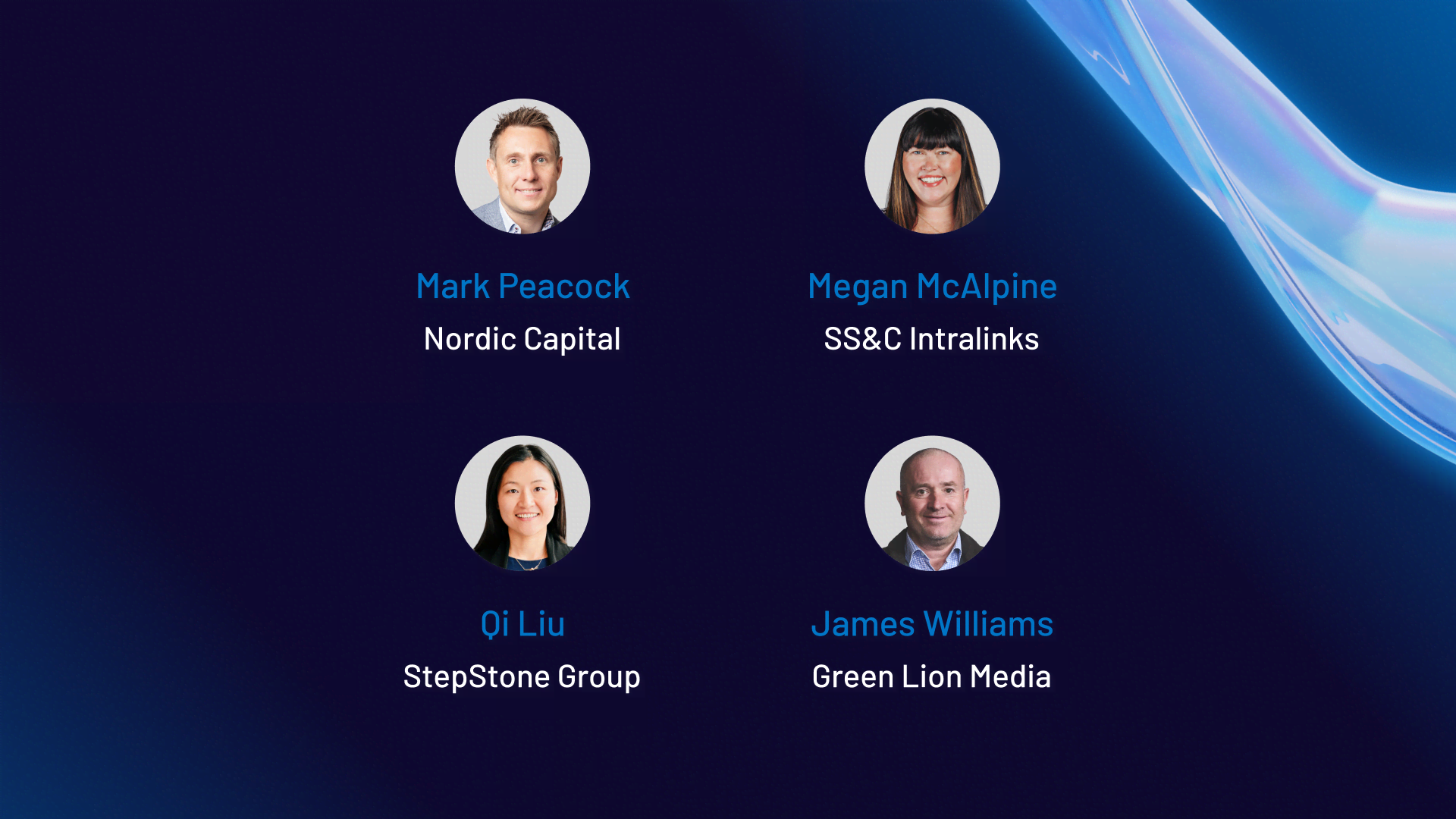
Panelists:
- Mark Peacock, Chief Technology Officer, Nordic Capital
- Qui Lui, Director & Head of AI, StepStone Group
- Meghan McAlpine, Senior Director, Product Marketing & Strategy, SS&C Intralinks
Moderator:
- James Williams, Founder, Green Lion Media
Running time:
- 1 hour
Transcript
James Williams
00:00 - 03:56
Yes. I'm getting ready for lift off.
Hello. Welcome, everybody, to today's podcast and webinar session.
Delighted to be kicking today off. And, my name is James Williams.
I'm the founder of Green Line Media and, very much looking forward to moderating today's session. For everybody joining, before we start, just, very quickly to let you know, on the right hand side of the screen, you will see a q and a tab.
If you could please submit your questions using the q and a tab during the course of the the next forty five or so minutes. We'll then take a few of your questions at the end.
Also, just to note that the session will be recorded, and it will be sent out to each and every one of you post the event. You will also see a link to the report appear during the q and a session, as I say, during the last ten minutes.
So just for a little bit of context. So in March 2026, SS and C Intralinks published its latest white paper entitled what AI adoption means for GPs and LPs.
The report argues that AI adoption in private markets has moved beyond early experimentation into a a second more practical phase where GPs and allocators are applying tools to specific workflows and competitive advantage increasingly depending on implementation speed and discipline. The report also warns that while AI can deepen insight from an unstructured data and improve decision making, the industry needs to guard against low quality AI generated data entering private market databases and investment processes.
So there's a very strong governance aspect to all of this as well. During the next forty five minutes, we'll run through some of the key themes that came out of that report and discuss the AI journey so far, the strategic shift from IT infrastructure to AI first investment firms, speed as a competitive advantage, the data frontier mastering unstructured information, trust, governance, and the human in the loop, future adoption, and final thoughts as we look ahead to the next five years.
So I'm delighted to be joined today to discuss these important themes by a a fantastic panel. We have Ki Lou, director and head of AI at StepStone Capital, Mark Peacock, chief technology officer at Nordic Capital, and Megan McAlpine, senior director of product marketing and strategy at SS and C Intralinks.
So thank you very much everyone for taking time out of your busy schedules to participate today. So let's kick things off by getting a snapshot of where each of your firms are on their AI journey, how you've been approaching embracing generative AI, and really what you consider to be the most important element from an infrastructure perspective.
And and maybe, Kian, I'll I'll bring you in to, kick things off.
Qi Liu
03:56 - 04:01
Great. Thanks, James.
Just confirming you guys can hear me okay.
Meghan McAlpine
04:01 - 04:02
Yep. You.
can.
Qi Liu
04:02 - 08:16
Great. Hi, everyone.
Thanks for joining. I am Kiryu, head of AI at Stepstone.
Been with Stepstone for, over a decade now. For those of you who are not familiar with private market asset investor manager, representing over a $100,000,000,000, of asset.
I actually, you know, started my career on the investment side, so I think it's a little bit, interesting to share a little bit of context in my background, and I think that it's really helpful in terms of how I think about AI and our overall AI, journey, at at the firm. And so I started on the investment side, spent decades sort of, you know, underwriting deals and, being the users of data.
Right? And then I moved over, to join our data science team and lead that team wrangling data, building quant models basis, based off of those data we have. So we're talking about structured data, tables and columns and rows and numbers.
And then fast forward to three years ago when ChattopiTE happened, I was just at the perfect spot to to lead the initiatives. And over the last three years, really took up the head of AI role across a step stone.
And so my, mandate really is, from wide. And so goes all the way from sort of enterprise functions or efficiency gain, productivity gain initiatives to, you know, what can AI unlock on a for our investment teams.
Right? So really, huge mandate and have done a lot. And so where we are in terms of our AI journey, like I said, we started about three years ago.
Initially, it was very much like, let's not do anything until we figure out, you know, data privacy issues, the risk of hallucination. How do we safeguard, you know, ultimately, we're responsible, right, for for what we produce and put in front of our clients.
And so, you know, we we put together a compliance, work group really quickly because, you know, whether you like it or not, people are going it's such a powerful tool and technology that an analyst associates gonna use it regardless whether you have a, compliant tool put in front of them or not. So we we very quickly recognize that and instead of just holding people back, we wanted to put put, a safe tool in people's hands so people can go ahead experiment with it in a very compliant way.
And so so we, we did a really quickly following Chargebee T moment and came up with AI policy and formed a centralized AI team, which I lead. And in terms of our model at StepStone, we have a hybrid model in both ways.
From the technology front, we're hybrid in that we have our centralized AI solutions team designing, the tech pipeline that touches anything that's proprietary to us. But at the same time, we, utilize vendor tools for, the more I think I would put them in sort of the commodity bucket of tools.
So I would put, you know, general data room due diligence in that camp. Some some of the tools that, you know, we use on on the, tax or legal side, I will put in in that camp things that we don't need to be the builders for.
But anything that touches our data and our proprietary insight, and maybe we'll go more deep, depth into it so I can sort of speak more specifically on examples. But if you think about, you know, what I see as, our our moat, a step stone, it's it's data.
And the data, not just the structured data, but also the unstructured data that sits on top. So having said that, so anything that, you know, our investment team does, like, how do we, translate the unstructured data into insights where my investment team not only can make faster, like, investment memos, turnaround, due diligence, but actually enable them to dig a level deeper that weren't possible before.
Right? So that's incredibly, valuable, like, two step stone because we have goals of data on that front. So that's where I've been spending a lot of, my time helping my team build is further all our data moat and our insight advantage.
James Williams
08:16 - 08:25
Fantastic. Thank you very much, Keith.
Mark, where are you on your AI journey?
Mark Peacock
08:25 - 13:30
It's probably followed a similar path. So so I'm the CTO at, Nordic Capital.
It's a much smaller fund, but we, did a very similar thing when ChatGPT came out. We put together an AI task force that that sits across the firm, and there's representatives from all parts of the firm.
Right? So it's not just the investment side, but also, IR and all the mid back office functions. And part of that is sort of the the governance, that we were talking about before.
But I think the main thing is sort of the the learning of what each, part of the business is doing so that we can kind of all feed off of each other and make sure that we're we're pushing each other in in the same direction. I think the the thing that happens when ChatGPT came out was that people started to get interested, but there was relatively small uptake.
Although, I mean, we did probably what most companies did and looked for the right tool. We did sort of our due diligence in terms of, you know, looking at the the tool itself, the security that we needed to put around it, the guardrails, whether we trusted the company, where does our data go, you know, all of that kind of due diligence to make sure that we could roll out ChatGPT safely and it was ChatGPT that we chose in the first wave.
Then we sat back a little bit and watched that generic tool as it got adopted through the firm. At the same time, we we looked at sort of these more niche tools.
Right? So that that sits vertically in in the business. So I think typical examples tend to be around, legal.
We also have ones in the IR, so responding to DDQs and and that kind of, thing. So they were relatively easy to to set up, at the beginning, and I think there were firms that were quick to kind of use AI, in those niche parts.
But we didn't really start to build anything, not until relatively recently. We sat back and watched these products being created.
What happened relatively recently, probably everybody's aware of Claude, but I think Claude have done an excellent job at, marketing AI probably for a more enterprise audience. And given and and off the back of that, we've now implemented Claude across the organization.
And I think simultaneously, there's been, you know, webinars like this. I think there's been people in the organization probably higher up who've started to understand the possibilities of AI.
And that that sort of awareness from our our leadership team has really been now pushing through the firm. So we're seeing the this adoption of Claude in its relatively vanilla state.
Right? So the the the chat tool that we use, but we see the adoption, going, quite well, very, very well, to the point where we started to do a lot of monitoring of how people are using it. So, I think that a typical thing you would look at, you know, is how many people, you know, weekly active users and how many tokens are people using it and all of those kind of what I like or leading indicators.
But we've kind of realized that that's perhaps it it's a good indicator, but it's not the best indicator. We're still finding the the ultimate best, but we've started to look at the prompts that people are using and put them in some sort of framework to understand, you know, is it high value p work that's being done? So, you know, market analysis, company analysis, that kind of thing.
Or is it sort of more low level, you know, translation of text from English to Swedish or or whatever it might be? And and given that kind of framework of of high value to to low value work, we're starting to kind of track where people are using, sort of the basic tools. And and as we deliver our adoption program, which which has started over the past few months, we want to see that increase.
Right? So we're we're we're very consciously making sure that people are using the tools in the way that we think is valuable in the context that we set. And then and then the adoption program.
Right? So so we've been pushing Claude, specifically, and doing sort of, typical training sessions that you might expect, and then also hackathons. So, you know, making sure we set aside time from, you know, people's very busy days to make sure that they're comfortable with these tools.
And and that's now reaping dividends because not only people are doing sort of the small, productivity sort of skills that that I think everyone can do, but we're also finding the people through these hackathons who are really sort of pushing the boundaries of what you can do with the the simple chat based tool, and are starting to to kind of put pressure on me in a good way, asking for, you know, different capabilities that they can then add into into these, chat tools in the forms of of connectors so that they can then, know, improve their work, improve the output, and start to kind of push the boundary of of the products that they're producing. It's, it's really kind of it's really quite exciting.
James Williams
13:30 - 13:56
Yeah. No.
That's brilliant. Wow.
There's a lot a lot a lot to, a lot going on there, which is fantastic in both of your organizations and and really interesting to to hear how well progressed you are in your, in your AI journey. And, Megan, I presume that you see a lot of variation across all the different clients that you speak with, and they're all at different stages of probably adoption right now.
Meghan McAlpine
13:56 - 15:36
Yeah. I mean, from, you know, from our standpoint of our company, you know, our parent company, SS and C, you know, we've always been a tech forward company.
You know, we we do have a sizable services business, but technology has really always been the backbone of our business. SS and C bought Blue Prism, I think, four years ago, which is a pioneer in agentic AI across, you know, numerous industries and use cases.
And at Intralinks, we're also very focused on a AI. We started investing in AI in 2018 when we created a a data science and, AI practice internally at Intralinks.
We were really deliberate about, building out the right foundation internally, making sure that we kind of had the right people in place and really the right data infrastructure. And then we integrated we started integrating AI into our virtual data room back in 2021.
And, initially, we were really focused on replacing kind of manual tasks and just trying to create operational efficiencies for deal teams. And then in 2023, we launched Linq, which is our proprietary AI engine, which is really purpose built for our clients, you know, across the deal side as well as private markets, hedge funds.
And we've integrated Link into our FundCenter platform, including, as you know, Mark was talking about, we have a AI powered DDQ tool, which really helps GPs complete DDQs, much more efficiently during the fundraising process. And we do have plans to kind of incorporate AI more into our platform, really in more of, like, that AI first, methodology, really to help our clients overall and just being more efficient.
James Williams
15:36 - 16:55
Yes. It'd be fascinating to see how the, the the adoption of AI certainly helps with the, certainly, functions like fundraising in particular with, I think given the competitive, environment right now, it's gonna be interesting to see how that yields dividends for for for GPs.
I wanna move. on to get a sense from Mark as to how you make that strategic shift from a more traditional sort of IT infrastructure, led organization to one that is more AI led.
Can you just sick explain a little bit about the cultural considerations that need to go into transitioning into a more AI focused management company. I'm sure that that there needs to be a a top down agreement, really, on on on everybody buying into the, the idea of of of how to move forward, and and I think it'd be interesting to understand how you've approached that from a cultural perspective.
Mark Peacock
16:55 - 19:28
I mean, we we tell it to all of our port codes. Right? So any any kind of transformation of of this scale needs to start at the top.
And in private equity or in, you know, in the manager and the GP, we're we're no different. And I think the, the the fact that Claude came around, and of the fact that was a lot of marketing around that.
And then a very simple thing for us, also helped. We all happen to be at the same conference with, sort of, an AI evangelizer who did a very good job of, making everybody interested, possibly a little bit scared, but having the leadership team in the same room with a dedicated amount of time to actually discuss and reflect on on what that, you know, that speaker had said, I think was was one of the catalyst to to having this as, you know, front and center, to to the firm strategy.
So, I mean, classic cliche thing, but it but it absolutely has started at the top. But now we have a leadership team who are are pushing hard, driving us hard, and starting to set set the goals.
And, after having set set the vision of being, you know, an AI led, organization. But then that has to trickle down.
Right? So so there are, I guess, hurdles or or, parts of, you know, the challenge that comes of making that or or making us as an organization more more AI led. I think one of the things is obviously a skills gap.
I mean, we're we we tend to pull in people and and employ people who are excellent at Excel and, analysts through an Excel type tool. I think we're seeing, that people who perhaps have more of an engineering background, who have spent some time coding, even if it's, you know, small amounts of, I don't know, VBA or Python.
We're seeing those kinds of people, now coming to the fore when we're starting to push Claude and and perhaps Claude code and sort of getting to into the more coding parts of things. So it's really up to us to make sure that, you know, we lift everybody, perhaps not to a full, engineer as as, you know, I spent much of my career, but but certainly moving towards, that kind of goal.
With the theory being that, you know, if you give people, any of the entire organization the skills and the tools to be able to do the job, then we're gonna get, a lot of very useful use cases being implemented by the organization on their own without necessarily needing IT. I think we'll come into where IT should be a bold, but just bringing people's up in terms of skills.
James Williams
19:28 - 19:29
Yes.
Mark Peacock
19:29 - 20:18
There's probably a lot to say around trust as well. And again, I think IT play an important role in making sure that, you can trust what the AI is coming out with to make sure that, you know, it's got context.
It's it's got the data it needs to be able to perform, and it's not hallucinating, and and making sure that that we set aside time to do this. I know my investment teams, and I'm sure I'm extremely representative of everyone, but there's you know, their their day job is is, you know, finding exciting companies to invest in.
Finding the time from these people is is extremely challenging. But when it's, you know, when it's driven from our leadership team, then that that does become slightly easier.
But there is a a very important part there to to set aside set aside time to to really dedicate to this this work.
James Williams
20:18 - 21:41
Yeah. I just wanna expand on that briefly.
And, again, I think it's given that it's important to have that that strategic alignment across the organization, I just wanna refer to specifically one area where AI is being utilized, within Nordic Capital with in respect to the investment team. So speed is a competitive advantage when it comes to compressing the deal funnel, and I think AI now is is starting to reap some very useful dividends in in using its ability to analyze and pass through a lot of data when you're doing that, pre investment analysis.
And I think as we highlighted in the report, Nordic Capital, it's your ambition to reduce the bid, no bid decision time from two weeks to forty eight hours. My question there is, can you use AI tools safely to remove emotional bias when evaluating bids, or or does it introduce new risk? And I I think what I'm referring to there is that potential for hallucinating.
Mark Peacock
21:41 - 24:08
It it is absolutely our goal, and I think it's one of the the important things that that one should consider, right, is is why you would be embarking on a transformation such as this. So the speed at which we can, you know, make a decision helps enormously with and perhaps even bias.
So there's, I mean, there's a few aspects, right, where we can be first to the to the draw when it comes to placing a bid. That's that's one thing.
But I think the thing that probably, excites the, the IC the most is the optionality that that that being quicker and being able to therefore look at more deals, will give to them so that they're able to select, deals out of a much wider, set of, projects that come down the pipe. And I actually think that might help bias, in a in a sense.
I'm I guess that's not where you were heading with the kind of hallucination aspect. But but given that you have more deals that you spent less personal time and also, you know, time with advisers or and and money with advisers, you you actually decrease the bias because you're looking at a at a project that has had, you know, very little or less human time and less money put towards it.
You're not as likely to jump onto it and say, yes, let's do this deal. You're.
absolutely right though that the hallucination part is an important aspect. I think there is a lot of things as I was referring to before that we'll probably come onto in terms of data.
We're making sure that the data available to the tools that we're using is of top quality. and readily available and that there's techniques to be able to make sure that we've got that structured and unstructured data available.
But it's also not the case that we need to use just an LLM in order to be able to make these decisions. We're starting to see, especially as we get our investment professionals using code to start to mix the probabilistic with the deterministic in order to be able to make a decision much quicker and being able to create these deterministic models through Claude code.
We're accelerating the ability to create them. But being able to mix this probabilistic and deterministic world means that we can come over some of the bias that one would get with hallucinating.
James Williams
24:08 - 24:37
Yeah. Key key what what how have you been approaching this within the step stone in terms of identifying maybe AI champions? Mark spoke earlier about running hackathons, and and how has that helped inform how you apply AI within your investment team to to to generate investment summaries and maybe improve the way that you're approaching your decision making within within the organization?
Qi Liu
24:37 - 28:51
Yeah. Happy to to jump in.
I think, you know, on the topic of putting tools to people's hand, that's absolutely, our, our our our goal and our our strategic thinking from the top down as well. So, like, we sit in the middle as a centralized AI solutions team, but, ultimately, is the, you know, the deal leads, the AI champions that we identify.
So, like, you know, from from our organization, we have a 60 person AI champion program across the firm. So we're about 1,300 people, globally.
And so so you you think about the ratio, and and these AI champions are sort of mid senior level people within each functional teams, that are empowered to experiment, tangle, and come up with ideas how to make, their workflows more efficient and more enabled to to to tap into the, large language model powers. And so from our investment team perspective, absolute absolutely agree with Mark.
It's not enough to just, you know, plug Claude into a large folder or data room and ask the question, you know, tell me about, you know, your views or merits and risk of this deal. That doesn't work.
Right? What you will get a a a answer, a possible answer, but that's not the answer you want to hang your hat on. And so how we approach it, like, to give you a concrete example of, you know, what Mark talked about, like, from our perspective, combining structure and structure data together to make your investment decisions much more backable is, for example, when we look at, like, a co investment deal, it could be it could be at a in health care tech space as an example.
And the the the SIEM and the deal room could say, okay, these are the seven value value creation initiatives, like m and a or, you know, operational efficiency through x y z, cost cutting, expanding geographically, whatever it may be, so in that data room. And then so what we do is we actually take this GP because we, you know, at StepStone, we've seen tons of deal flow.
And through our primary, secondary, co investment programs, we have tons of historical data, like structurally and unstructured data from this GP. And what we have done, you know, as a centralized AI team effort is going back in history, ingested all of their investment, memos that we have seen, but also all the PPM DDQs that we have, we have, received during our investment due diligence process and actually, like, benchmark each one of their portfolio companies that we have exposure to historically to see what the value creation initiatives were for each of those deals.
And then throughout time, track how these, initial, value creation initiatives have panned out. Right? Because if you're just looking at one snapshot from this GP in in terms of quarterly report, you kinda lose all the history.
Like, the strategy could have changed. Something could have dropped throughout the quarters.
And if you're just looking at, like, the most recent ones, you would never actually know. Only if you create a very methodical historical time series tracking each, you portfolio companies, then now it starts to get interesting.
And so, like, in this example of, you know, healthcare tech company, we're able to say, okay, of, you know, M and A, this GP has done it 18 times in its, you know, 18 prior portfolio companies. They are successful 83% of time.
And those numbers are not generated by AI. AI help us got there, but I'm able to back into telling you exactly why it's 83, not 84%, not 80%.
Right? And so what I tell my investment team member is that it's not enough to just get a probable answer from AI. You need to be able to, you know, defend the answer when I when you say, hey.
It's 80% probable. Why is it not 78%? Like, what differentiate, 80% deal to 85% deal? And so that's how we approach it.
And I think, you know, that really stemmed from, the the fact that we we have a in house spy data platform. So that's our research reporting data data platform that's built built in house as Stepstone since inception.
And because.
James Williams
28:51 - 28:51
what.
Qi Liu
28:51 - 28:53
that, we were always.
James Williams
28:53 - 28:53
spy?
Qi Liu
28:53 - 28:57
very focused on sorry. Can you hear me?
James Williams
28:57 - 29:00
Yeah. What can you just say what spy stands for?
Qi Liu
29:00 - 30:09
Ah, okay. It says StepStone Proprietary Intelligent Platform.
We, it's a it's our, data data platform for both internal use, but also, you know, our clients as well. And it has two parts, reporting and research.
And so my my punchline there is that I think, you know, because we in house this, data platform initiative since inception, some of our peers sort of outsource this reporting, function externally. But because we kept it internally internal, it made us really, huge believers in the hygienes of data and how we, you know, always thinking about how we capture more data.
Back then, it wasn't it wasn't because of GenAI. But fast forward to today, it gave us a huge advantage because all our unstructured data structured data are organized really well.
And I think that's that's that's a huge, convenience, today when I think about how I sort of built a knowledge graph of all the information we have. Right? Because we we have it already, for the most part, organized.
We're not a 100% there. There's a lot more things I want to do.
But,.
James Williams
30:09 - 30:10
Right.
Qi Liu
30:10 - 30:27
but, yeah, it's it's a it's like like Marsha, it's really exciting times putting you know, enabling our investment teams to do a lot, ultimately, comes from sort of the bottoms up, grassroots, because. that that that's when it when it matters, when people can actually use it to to, in their day to day.
James Williams
30:27 - 31:32
Yeah. I mean, I think you're both pioneers really in in in the fact that you've developed very sophisticated data platforms.
You know, you have a lot of that proprietary data that sits in in in house. It hasn't been outsourced.
So you have a very deep data lake, if I can sort of call it that, that that you can I think that's really so important when organizations are looking to utilize AI, Gen AI specifically in a in a very, you know, a very, sophisticated way because it all depends on the raw material, which is the data, structured and unstructured? And I think, Megan, I think that ability now to, master, you know, combining the unstructured messy data with with structured data. I think that's a a huge opportunity now going forward in this this next frontier for for data management.
Are you are you seeing that?
Meghan McAlpine
31:32 - 33:33
Yeah. For sure.
I mean, I think standardization in the industry has always been an issue. I think there's always been a lot of, you know, bespoke templates and proprietary formats out there, and every GP obviously reports differently.
Every LP has their own requirements that they're they're looking to get from their GPs. And I know, you know, ILPA has done a lot of work, trying to move the needle on standardization and, you know, initiatives like the their ILPA reporting template are very helpful.
And it's definitely something that we take seriously at Intralinks. You know, we actively work with ILPA.
We've incorporated their standards into our platform really to help drive consistency across the industry. But we all know that, you know, bespoke reporting isn't going away.
And I think there will always be, you know, some degree of customization, to some extent. And I think our view is you you kinda have to build to the data that actually exists today.
And that's really how it's really informed how, like, our approach to building this kind of AI first platform for private markets. You know, we're not bolting on some sort of generic AI into, like, a generic product.
We've really built our platform keeping in mind, you know, private markets workflows, the data that they're getting, and the users just to make sure that it's meeting kind of the needs of the industry. And I think you also have to keep in mind that AI really can't solve everything, you know.
I think particularly with imperfect data, and I think the goal isn't to wait until you have, you know, some perfect data environment before deploying AI. I think that's that day is never gonna come.
I think the goal is really to extract, insights from the data you actually have today. And I think it's also just important to be make sure you're working with providers that do have that kind of industry expertise and that AI deep know how.
I think that makes a huge difference as well within this market for sure.
James Williams
33:33 - 33:54
Mark, Nordic Capital has its cockpit, data platform, which I'm interested to hear from you how you've been approaching combining the unstructured data with structured data to drive deeper insights on existing poor code performance, maybe. things like Salesforce productivity?
Mark Peacock
33:54 - 33:55
So.
James Williams
33:55 - 34:01
What what what what are you, what what are you seeing at the moment?
Mark Peacock
34:01 - 37:57
I I think, you know, very similar to Stepstone and probably many others, we kind of realized that that, you know, our, IP sits within the data that we have. And it was kind of a magic moment, right, when large language models are able to actually understand all of the unstructured data that we have because most of it, or at least, you know, some of the good stuff that we wanna get into is in an instruct unstructured data.
I mean, how on earth would we have ever gone through all of the expert calls that we've made over, you know, the ten, fifteen years that we're looking at? So, I mean, it just wouldn't have been possible and and now it is. So it really is kind of bringing all of that unstructured data that we have.
It's the structured data that sits within the firm itself about, you know, the the performance of the portfolio companies or the performance of the fund or, you know, the performance of the deals as the as they move through the flow and why did this one fail and and why did we say no to this one, and all of that kind of thing that we can start to pull together. I I would say that that one thing that we're doing around that is is probably forcing some structure into some of the unstructured data that we have.
So What do I mean by that? I mean, it's it's actually easier to query structured data. But given some of these things sit in, you know, I don't know, IC memos or or decks that were produced, you know, during a a deal, What we're starting to do now is pull structure out of those unstructured data and then put it into a classic database.
And that helps us, you know, to query and find the right information that we can then present to an NLM in some of these use cases so that we're not just throwing everything at it, which tends to, you know, we will know the problem with a large amount of data being thrown to an LLM. We're.
trying to have some structure, make sure that we're putting the right things into the LLM to try and get a good answer out and then making sure that we've got traceability all the way down. That's the internal stuff, but you mentioned Cockpit.
Cockpit is something that we've developed alongside our portfolio companies so that we, have the ability to pull into sort of standardized, reporting platform, all of the financial data that you would expect, but also operational KPIs. We typically look at the performance of the sales team.
We look at for the tech companies that we invest in, look at the performance of the product and the development teams. We also have the data that's coming from the portfolio companies in in terms of financial and and operational KPIs, which just adds to this kind of rich mix of of data that we now have available, to to the, skills and and so on that we're building.
Just a quick note on the skills. We're doing the bottom up approach and I think that's an excellent way to get people interested and get the investment teams working with these tools and finding things that work from them.
But we're also now deliberately doing sort of a top down approach. So so a value stream mapping exercise and looking at the deal flow process and what, AI skills that we would want to have as part of that.
And then very deliberately making sure that we've got the the data and capability, the I you know, the the, IT infrastructure, if you like, that sits underneath. And doing that mapping makes you realize that that having you know, there's a a ton of skills that we would want to develop.
So in deal screening or in DD or even when you get to sort of presenting an IC that all require, information from previous deals. So that now informs the the priority that we're going to put across or that we put across the the lower level tools that we make available to the teams that are sitting on top of all of this internal and external data.
So we're we're starting to kind of really see that that full stack from from, AI use case all the way through to, you know, the matrix of data that's sitting in the the data lake.
James Williams
37:57 - 38:55
I think, data privacy is is certainly a a a a key factor in in terms of how organizations are approaching how best to utilize AI today. There has to be a bit of a careful balancing act between innovation and not transgressing compliance and regulatory, considerations, and and rules.
So I I wonder, Key, how are you approaching that balancing act where it's still important to maintain the human in the loop, and that effective oversight of what the AI is doing. in a in a way that.
but in a way that still promotes innovation without transgressing the sort of the the the the compliance and the governance, aspect.
Qi Liu
38:55 - 42:05
I think, you know, I think repetition repetition is the key. We constantly have to remind people, here's AI policy, here's what's allowed, what's not allowed.
And then also be very proactive in terms of thinking through how we can help our sort of AI champions and the grass root, you know, analyst associates who are developing these cloud, artifact and skills. How do we sort of guide them so that we are not taking on additional risk? And.
so one example of that is that we made a, we we we coded up an AI security check, as an artifact that they could just call within, you know, their cloud code, and we also centralize that. And so so making making sure, you know, like so that's, like, sort of for the, the tools that, you know, every day, I could have 50 submissions of different skills around the around the firm.
Right? And so so that's also raise up an important question as sort of senior management level that I need to think about, which is how much of it I think you touched on this a little bit, James. Like, how how much of this is actually productive versus, just tinkling with a new cool tool and actually.
may not be as additive value add? And so so I think I think that's going to be something that that is going to be around. Right? Like, you you can't really, ensure that everyone is using their times most efficiently, but you could help them by giving them sort of centralized platform.
One, you know, making sure, foremost, their skills and apps that they coded up are secure, and two, give people a platform to actually search. Like, so you don't have to reinvent the wheel every single time.
If you give a centralized depository of apps and skills and and, agents, right, that people have already, you know, tested, back tested, iterated, checked, then, you know, you could just leverage that and tweak it to to your utility. So so we are doing that as well.
But in terms of, sort of, you know, the the the the risk of using AI, and also maybe being overreliant on AI outputs, I constantly have to remind my team, we have AI office hour, step stone every two weeks that that my team host, and we just have to, you know, keep on reminding you that you're responsible for the output. You should view it as a, you know, supercharged tool, your system.
But, ultimately, you you need to be able to defend. You can't just tell tell me that this is what Claude, answer is.
Right? That doesn't doesn't doesn't work. And so.
having that mindset sort of, you know, really repeated and and and pushed down, I think that that does a lot. Just have people with that principle mindset of this is what I own, and this is what I'm supposed to do.
And so I think because you cannot control everything that will come out of this, but if you have the right process and right discipline to begin with, I think that that could go a long mile.
James Williams
42:05 - 42:33
Because, also, it could be that the regulators might wanna get evidence of well, in any particular example of how the AI is maybe being used for potentially for reporting purposes. They may query figures, and and you've gotta be able to have that clear audit trail to be able to justify why you've reported in that particular way or whatever it might be.
So I think just I think that's a really strong mindset to to adopt, going forward. Megan,.
Meghan McAlpine
42:33 - 42:33
Yeah.
James Williams
42:33 - 42:34
do you.
Meghan McAlpine
42:34 - 42:40
love to I was. gonna say I'd love to jump in there.
I think, you know, data privacy from our perspective is obviously a very important thing to focus on. I think,.
James Williams
42:40 - 42:41
Yeah.
Meghan McAlpine
42:41 - 44:36
particularly firms are sharing, you know, very sensitive information, you know, on the deal side, investor information, performance data. And so at Interlinks, for us, we really wanna make sure that the AI is surfacing the right information to the right people.
For example, in a deal environment, you might have, you know, buyers, sellers, advisors, legal teams who all have different permissions to different information within that data room. So the AI really has to respect those permission boundaries.
You can't have confidential information being sourced up to someone who really isn't clear to see that. And we're actually seeing, you know, kind of a disconcerting thing where some people are downloading information, sensitive information from data rooms and then uploading them into external AI tools, because they wanna be able to utilize, you know, the AI to analyze the documents.
But, you know, obviously, I think that's concerning disconcerting because once it leaves that secure perimeter of the data room, you really don't have control over it. So at Intralinks, really, to reduce that risk, we've built AI natively into our platform so that users can really get that intelligence, and the analytics without having to go outside of the platform.
And, additionally, we've also developed, you know, an MCP connector, so, essentially, a secure data integration layer that allows preapproved AI applications to interact directly with the data inside of our platform without. any documents ever getting downloaded.
So these tools kind of operate entirely within our platform. So the permissions are maintained through APIs.
And then I think to your point, James, you know, every single action then is fully auditable. So it's under the that user's credentials.
So I think you get, you know, the efficiency and intelligence of an AI tool that maybe you're used to using, but you have that same security and auditability that you'd expect from the data room itself.
James Williams
44:36 - 44:37
Yeah.
Meghan McAlpine
44:37 - 44:40
And even even with our AI, you know, DDQ.
Qi Liu
44:40 - 44:41
For our internal,.
Meghan McAlpine
44:41 - 44:48
sorry. Yeah.
I was just gonna. say just,.
Qi Liu
44:48 - 44:49
ahead, Megan.
Meghan McAlpine
44:49 - 45:23
another example, you know, for our AI DDQ tool, we're very concerned about data privacy and security there as well. So that we allow, fund managers to upload information.
They have a data library. Then our DDQ tool will search that, return a proposed response for the DDQ, but that information is never stored in our in our interlinks database.
So the data stays kinda where it belongs. So, you know, I think making sure you have a platform that is secure, permissioned, auditable, and you know what's happening with your data, I think, is.
really important.
James Williams
45:23 - 45:29
Okay. Just a minute before I move to the final question.
Do you wanna add something?
Qi Liu
45:29 - 47:23
Yeah. I I exactly right.
So for us, like, the the knowledge web that I talked about, the knowledge, you know, the top we have, you know, cover 19,000 plus GPs over 285,000 investments, across our data platforms. There's huge amount of data, and there's huge amount of unstructured insights, whether it's, you know, quarterly reports or it's our 6,000 meeting notes our investment professional take, with our GPs over a year.
It's all we we vectorize that, host that all internally in our data infrastructure. And so that that never leaves out our, four walls.
Exactly same. Like, I'm terrified of so, like, so that that is one one risk, which is, you know, try to control.
The other risk is on the structured data side. How do you sort of like, if you plug, you know, quad into your your your data lake, have to think really hard to prevent one.
Like, are people gonna be interpreting the data, in the right way, with the right sort of, you know, that data science mindset in that, you know, data needs to be visorized. How do you use it appropriately? So, like, are they drawing the right conclusion from from your data tables even if you enable the tool? So that's one thing that I encourage everyone to think about.
The other one is even if you could put guardrails and preventions and and all that in place to prevent people from mass dump the the data, I I still worry that there's, you know, ways that people can go around it and then walk away with, you know, ten ten ten hundred thousand rows of data, like, at once. Like, I I don't want that to happen.
Right? So so we have to be conscious of, and be very protective, of the data that is, it is such you know, it's, it's it's it's our mode. It's it's our, you know, privilege to be able to work with the data, so treat it with with care.
James Williams
47:23 - 48:19
Absolutely. No, Previs.
I think that's exactly right. Nothing needs to end up inadvertently going out into the public domain because of perhaps a lack of awareness or training or or or just understanding of how to really safely use the, the AI.
It could be a so I think that's absolutely vital. Let's just spend the last three or four minutes before I could take questions from the audience.
Let's just look ahead at future adoption. I'll I'll kinda combine my last few questions into one.
I think we've come a long way just in the last two years with with how things have been just developing a great net speed with with with AI. Mark, if I was to ask you to snap your fingers and and you had the the the ideal AI tool today that you could give to your colleagues, what what would that be and why?
Mark Peacock
48:19 - 49:17
The non hallucinating one. No.
But assuming that's not gonna happen, and I think, the way these things are built means that it it never will right there, probabilistic by nature. Probably a market sizing one.
I'm gonna be very concrete and say that, if we could have a skill that could be able to tell us the market size of any particular market that we're looking at, just from doing that that value stream mapping that I mentioned before, market sizing comes up a lot. And it's also got one of the, the most, the biggest price tags on when we go and ask external advisers to do it.
And it's one that we, you know, we base a lot of our, decisions or, you know, a lot of the decisions we make around around market sizing. So, yeah, strangely, I think that's the one that I would like to have as a skill that we could we can absolutely rely on.
And I mean, of course, we're looking into it, but but, yeah, that's the that's the snap fingers one, I think.
James Williams
49:17 - 49:40
Yeah. No.
That's a good one. What about you, Ki, given, again, where we've come from and maybe where we will be in the next sort of five years at least? Well, no.
The next four years by 2030. What what would you what would you like to have today that perhaps, you know, could be with us in the the next few years?
Qi Liu
49:40 - 50:32
I think, I'll answer it a little bit differently. Instead of tool, what I would like is to see, meaningful uptake of UI utility across all knowledge workflow.
So a step stone, I think today if I sort of measure by just raw measures of use of AI, I think we're pretty close to a 100% adoption. Somebody using AI, over past thirty days.
Right? But, in in that number, there's big range of power users and then also bottom quartile users. If I could see, everybody sort of like, the bottom quartile users today are, you know, moved up significantly because I think it's it is such a powerful tool that everybody need to lean into and then how it takes shape.
It really is up to the individual.
James Williams
50:32 - 50:34
Yeah. Michael?
Qi Liu
50:34 - 50:51
And that's when the most interesting tools will will come up. It wouldn't be, I'm sure there's gonna be a lot of, creativity coming coming from the bottom up.
James Williams
50:51 - 50:58
Absolutely. Absolutely.
Megan, what what about you? Before we take the questions from the audience, what what what are.
Meghan McAlpine
50:58 - 51:54
I think I would say, in a different way, kind of looking at it more from, like, a a GP or fund manager's perspective. I think, you know, we we've seen talking to clients, we see things people run the gamut.
Right? People that are building their own tools internally, kinda using cloud code, to those that are have have just been standing by the sidelines, and then kind of everything in between. So I think, I I think fund managers should be looking for tools that can really help them scale, and help them be more efficient.
And I think, you know, as we move into the next, you know, four, five years, I think, first of all, the last several months have been so transformational that I don't know if we can predict what's gonna happen in the next, you know, few years. But I think that it I think that the point for fund managers is they really can't be standing by the sidelines.
So they have to figure out kinda what their AR strategy is and where they're going. They have to kinda dive in and figure that out, today for sure.
James Williams
51:54 - 51:55
Yeah. I know.
Mark Peacock
51:55 - 51:55
I.
James Williams
51:55 - 51:55
sure.
Mark Peacock
51:55 - 52:09
I predict if I can make a crazy prediction. I predict the demise of Microsoft Office.
I don't think we'll be using Excel, and I don't think we'll be using PowerPoint, and I don't think we'll be using Word anywhere near as much as we do today.
James Williams
52:09 - 52:20
Interesting. Well, is that a bold prediction? No.
I like I like it, Mark. Well, I'm I'm I'm let's see what let's see.
How soon do you think that could even happen?
Mark Peacock
52:20 - 52:24
I, I think in the next, couple of years, two, three years,.
James Williams
52:24 - 52:25
Yeah.
Mark Peacock
52:25 - 52:39
We're already thinking about how to, convert some of the work that we do in Excel into code, which is now perfectly reasonable for people to write themselves, like our investment teams to write themselves.
James Williams
52:39 - 52:39
Got.
Mark Peacock
52:39 - 52:39
yeah. I'll.
James Williams
52:39 - 52:40
Yeah. That's.
Mark Peacock
52:40 - 52:43
be I'll be proven totally wrong, I'm sure. But,.
James Williams
52:43 - 53:17
yeah. No.
No. No.
No. We'll see.
Let's take a question from the audience. If I were a a competitor sorry.
Let me start again. So if a competitor were using AI more aggressively than you today, what would you worry about in terms of losing ground? Mark, what what how would you think about that if a fellow GP was being a little more aggressive? Would that, would you stick to just stick to the discipline, or would you how would you how would you approach that?
Mark Peacock
53:17 - 53:21
approach on I mean, speed of execution would be my concern.
James Williams
53:21 - 53:21
Right.
Mark Peacock
53:21 - 53:33
That they're able to come up with a quality result in a much quick you know, in a much quicker pace, and and and sort of beat us to the draw. I think that would that would be my concern for now.
James Williams
53:33 - 53:33
Yeah.
Mark Peacock
53:33 - 53:37
And I mean, it's it's speed, quality, and,.
James Williams
53:37 - 53:37
Yeah.
Mark Peacock
53:37 - 53:40
yeah, speed and quality, I think, are the two things.
James Williams
53:40 - 54:06
There's another there's another good question here, Key. Maybe I'll put it to you.
But how would you win over senior partners or investment committee members who are maybe skeptical about AI? Because, you know, every organization, there's gonna be differences of of opinion. How do you win over those colleagues if they are, slightly reticent?
Qi Liu
54:06 - 55:14
Yeah. I think, in, like, the idea, the support of AI has been super overwhelming.
You know, as head of AI sitting at Stepstone all the way from our CEO, COO, all the asset class heads has been overwhelmingly supportive in in what we do on the AI front. But you're right.
There are going to be, sort of team leads who are resistance. Maybe they don't they haven't had the time to experience and and see what it could do, or they see headlines about hallucination and risk and got really skeptical.
But I think, you know, don't don't don't overpromise. Right? Like, that's that's the wrong way to approach it, but concretely show them, concrete, you know, winning cases of using AI.
When I could point to, okay, this is what we did for our audited financial statement for our fund accounting team. This is what we did for our legal team.
This is what we did for our primary due diligence, team for for private equity. You can point to, you know, a a product and output a, workflow that that works and and can be plug and play.
I think that that makes it really easy to win them over.
James Williams
55:14 - 55:41
Yeah. That's another good question for you, Ki and Megan, if I could put it to you.
Given that you're investing across multiple GPs, these GPs are all gonna be providing their reporting in different formats and different portals. Key, how do you how do you turn that into structured data? Or are you is that is that how we use use that? How do you how how do you how do you even begin to think about that?
Qi Liu
55:41 - 57:11
Yeah. Yeah.
That's, you know, what we do already. Right? We collect on the reporting side, we I don't know.
50,000 plus funds in our in our database, and and you bet they all come in in different formats. And so it's not a new problem.
Just Jenny, I makes it much easier to collect even more beyond sort of, the traditional reporting metrics. And, and that's what language model is really good at.
You have to build in guardrails and double checking and logics to make sure, you know, what AI give you makes sense by checking against last year, last quarter's number and building some logics and then flag things that looks out of line and also give people sort of, a really easy way click to open to the source file to validate. Because if you don't make it easy, people aren't gonna check.
Right? And so I think, in terms of, like, technology itself, like, I think it's a pretty low hanging fruit use case of finding information from from a report that has different format. I I don't think there's any, huge I mean, you have to think about, like, you know, watermarks and what visual models you might need to use and what sort.
of, future examples you might want to produce. But I think from the technology side, it's it's really easy.
From the, making sure there's no hallucination risk side, you have to design a system where it's easy for people to check and then build in all the logics that you could think about from, you know, any pre traditional data science y stuff, to to build? in in the process.
James Williams
57:11 - 57:14
Megan, did. did you want anything?
Meghan McAlpine
57:14 - 58:00
Yeah. I would I would reiterate that.
I mean, I think they're you know, we've been scraping data from GP reports for a long time. I think they're obviously like I mentioned before, there's a lot of bespoke reporting, different templates that people that GPs are using.
Everyone's reporting in a different way. LPs want different information from their GPs.
But I think there are tools in place now to gather that information now. I think they're they're pretty good, and and LPs are getting that information.
But I think that, you know, the tools obviously need to be augmented with human judgment. Right? Like, it cannot replace that.
So I. think they they shouldn't be relying on that solely to make the decision that they should be looking at it with a trained eye, to understand if there are discrepancies or something coming up that doesn't look right, I think.
But it does it'll help give them better information to kinda make those decisions, I feel like.
James Williams
58:00 - 58:29
Yeah. Yeah.
That's interesting. Yeah.
I just, I'm gonna just have one oh, we just have one more question in. Mark, maybe we got one minute or I'll put you under pressure here.
How do you see how do you see these, AI firms changing if or when that's a good question. If or when they go public, and then there's a lot of talk about, anthropic maybe IPO ing this year.
That could be interesting.
Mark Peacock
58:29 - 58:30
That's a wild question.
Qi Liu
58:30 - 58:33
I have a quick I have.
Mark Peacock
58:33 - 58:37
guessing my usage cost is gonna go up. That's my.
first answer. Go on, Keith.
Qi Liu
58:37 - 58:38
answer,.
James Williams
58:38 - 58:39
Yeah.
Qi Liu
58:39 - 58:40
Mark.
James Williams
58:40 - 58:41
Key?
Mark Peacock
58:41 - 58:42
Oh, is that your answer as well?
Qi Liu
58:42 - 58:48
That's exactly where I'm going. You.
bet. the token price will go up.
James Williams
58:48 - 01:01:01
Yeah. Yeah.
Well, this has been fascinating. We could have plenty more.
I'd love to go through way more questions. I mean, this has been a really fantastic discussion.
today, and, I certainly would like to thank each of you for for taking your time today and to the audience for for listening. Just a quick takeaway from me.
I mean, we've covered a lot of ground with this. I I think it's pretty evident from what we've heard that that within private markets, organizations are really well on their journey now to thinking about data privacy, taking a compliance first approach to adopting success in a very safe way, these AI tools.
I think it's important to identify AI champions internally, especially when it comes to developing in house AI specific tools to to be trained on your proprietary data. So I think that's a key consideration.
Training, obviously, is a an ongoing consideration as well. It also seems pretty evident that that there are now with these AI specific task forces in place, this this is helping to identify where to use AI, not only within the investment function, you know, pre deal sourcing and due diligence and analysis, but also mid office and, back office as well from, LP reporting to financial analysis and and and and cash flow management.
Plenty of things to consider there across the organization. But I think what's critical is that you have that top down senior leadership leading division and and really making sure that everybody's pushing together, you know, in the same direction.
Just the last thing that Mark mentioned, which I thought was very interesting, was monitoring usage. I think that could be really fascinating to help GPs and allocators identify internally how is AI being used, where is it most being used, what is it being used for, and and how does that help inform us, you know, think about getting the most out of the, the AI that, that we're, we're adopting.
Mark Peacock
01:01:01 - 01:01:01
Thanks.
James Williams
01:01:01 - 01:01:09
So, thank you all so much for your time today. It's been fascinating, and, thank you all for listening.
Meghan McAlpine
01:01:09 - 01:01:11
Thank you so much.
Qi Liu
01:01:11 - 01:01:12
Thank you.