
APAC Private Markets Spotlight: Who Will Win LP Capital in 2026?
LPs expect allocations and deal activity to rise in 2026 — but where will the capital flow?
Join our panel of APAC alternative investment professionals as they react to exclusive data from the 2026 LP Survey and share insights on the trends shaping GP-LP dynamics across the region.
You’ll hear about:
- LP allocation plans for 2026
- Preferred regions, sectors and asset classes
- Emerging liquidity strategies drawing LP interest
- Key considerations LPs weigh when evaluating GPs
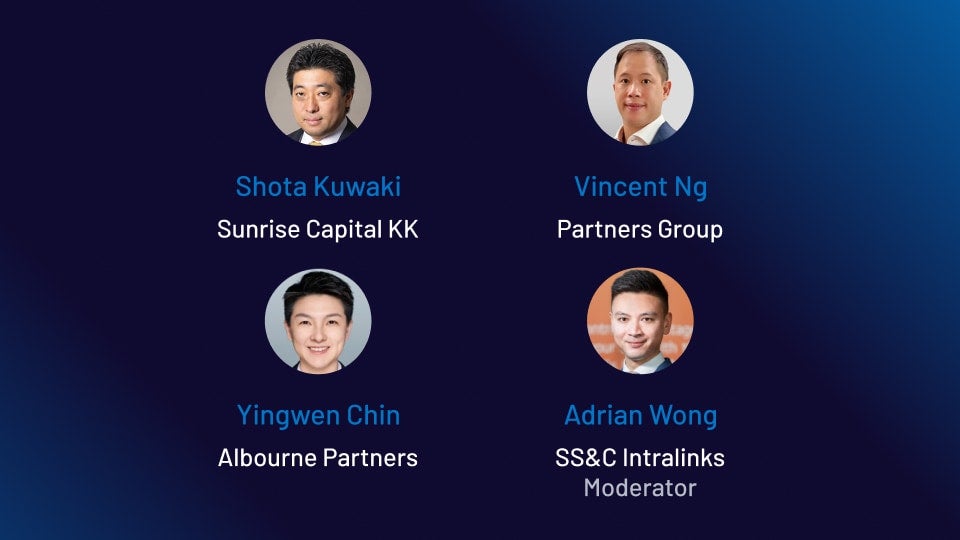
Panelists:
- Shota Kuwaki, Managing Director, Sunrise Capital KK
- Vincent Ng, Managing Director, Co-Head of Asia, Partners Group
- Yingwen Chin, Partner - Private Markets IDD, Albourne Partners
Moderator:
- Adrian Wong, Senior Manager, Alternative Investments – North Asia, SS&C Intralinks
Running time:
- 45 minutes
Transcript
Adrian Wong
00:06 - 03:57
Good morning and good afternoon, everyone. Thank you for joining us today at the SS&C Intralinks, APAC private market spotlight webinar, titled who will win LP Capital 2026.
My name is Adrian Wong, senior manager at SS and C Intralinks, leading the North Asia alternative investment team, and I'll be the moderator today. So first question for you, audience, Did you know LPI allocations to private assets are expected to reach record highs in 2026? In today's webinar session, we are very excited to be joined by a panel of alternative investment experts who will be sharing their perspectives and insights on the evolving landscape of alternative investments across Asia Pac.
Drawing on insights from the latest SS&C Intralinks 2026 LP survey, we'll take a closer look at the market dynamics that is shaping 2025, the shift in GP and LP sentiments, and where capital is likely to flow in 2026. The LP survey report will also be available for download simply by clicking on the banner at the bottom of your screen.
Allow me to introduce our distinguished group of panelists. Starting from miss Yingwen Chin, partner of private market IDD at Albourne Partners, followed by mister Shota Kawaki, managing director at Sunrise Capital KK.
Last but not least, mister Vincent Ng, managing director and co head of Asia at Partners Group. Our discussion today will focus on a few areas.
The 2025 macro outlook and how it set the tone for LP allocation in 2026 from preferred regions, sectors, asset classes, to fund structures. We'll also go over the Asia Pac deal activities and challenges so far this year, and more importantly, key risks and opportunities ahead of us.
Aside from that, we'll also touch on how GP and LP relationship has been evolving and make growing demands for transparency and valuation standards. Last but not least, and hopefully we have the time for it, we will discuss about AI and tech adoption.
Yes. We cannot avoid not talking about this topic.
How is it shaping investment strategies and operational efficiency? Feel free to submit your questions anytime in the chat box. Any questions post any question post are confidential, and we will get to your question in the order which they are received.
In case we cannot get to your questions within today's session, please feel free to leave your name next to your question so we can get back to you. So without further ado, let's dive into the discussion.
Giving everyone a bit of context, on a macro level, we had a slower than expected start in 2025, mainly contributed by the geopolitical tension, tariffs, and fluctuations of interest rates. Despite that, private markets have been resilient with 60% of LPs reported their portfolio exceeded expectations.
With that, 86% of LPs actually plan to increase their allocation to alternatives heading into 2026. So while Europe has gained stability, various Asia strategies continue to grow and diversify despite currency and portfolio complexities.
In that context, I would like to direct my very first question to Yingwen. So Yingwen, how do you see LP appetite shifts throughout 2025 given the current market performance in policy changes?
Yingwen Chin
03:57 - 06:07
Sure. Thanks.
Thank you, Adrian. So I think from from our vantage point, I I would kind of divide the year into kind of pre and post liberation day.
So post liberation day, I think what was, the the immediate kind of knee jerk reaction from, from LPs that we observed was, you know, most people's portfolios, on a private market side tends to be over indexed to The US. So we're talking anywhere between kind of, you know, 60 to 70%, typically, that's exposed to The US.
And post Liberation Day, I think that there was an immediate kind of reaction of, oh, okay. Do we have a little bit too much US now? Should we start considering other geographies? And what we've observed is that the first stop, first port of call has been Europe.
The thing with Europe is it's not it's not been a big enough market, to take in all that that kind of outflow of capital, or potential outflow of capital. And on the back of that, we are now also seeing, an increased, we're not seeing interest in Asia.
The story in Asia is is a little bit bifurcated because, you know, we call it one region, but it really is something like 15 different countries, that are investable. So I think I'll group them into, you know, first group, the Pan Asia funds.
You know, the the Pan Asia funds raising this year have actually been sucking in a lot of capital. I think if they all hit their target fundraisers, we're talking about something like 35 to $37,000,000,000, going into three pan agent funds.
Trickling down, I would say on a single country basis, Japan has actually been, one of the most active markets, that we're seeing clients are interested in. Japan fundraising this year, has been, you know, has been phenomenal, as has deal making.
I think every other week, we're seeing a new headline on on Feet about the big the big, big cap funds, fighting for some deals. But, yeah, the action doesn't just stop there.
It's it's also in the, the middle market, segment, that we're we're seeing.
Adrian Wong
06:07 - 06:33
Thank you very much, Yingwen Chin. Segue to to Vincent, do you share some similar observation, as partners group have been heavily involved in in Europe, with headquarters there? Any sense of, capital inflow, say, regardless where is it from, but into Europe and followed by, additional allocation to to Asia.
Vincent Ng
06:33 - 08:29
So on an overall basis, echoing from Ng point, it's been notable very notable through the year, but very much so post Liberation Day, where a lot of our investors have been proactively seeking for additional exposure to Europe for sure. And that's no more noticeable in where we structured over a third of our AUM globally is structured in the form of very bespoke tailored mandates.
And the beauty of that is you can pivot and shift at a very at any time you want. And so that gives us a great indicator because a lot of our existing investors have been coming to us and say, hey, to anyone's point, we have over historical allocation to The US.
Go forward for our mandates. Can we make a pivot and a shift to increase our allocation to Europe, often at the expense of The US.
So we're seeing a lot of info from that perspective, and a lot of proactive investor requests for that sort of action to be taken. Asia has also been featured in a lot of those conversations.
More broader conversations, how do we sort of reallocate part of that capital pool to the Asian markets on a broad scale basis, mostly across the sort of Pan Pan region. And this is all understandable, particularly in Europe's side, although it still has its own challenges.
If you look at the metrics from deal flow, from valuation, as well as sort of leverage facilities available, on a relative basis is actually quite appealing when you compare it to markets like The US. Although we're very heavily invested in The US and we will continue to be so.
Right now, the tailwind for the European conversation is very robust, and we see that will continue for at least the next twelve, eighteen months, as we go forward from here.
Adrian Wong
08:29 - 09:09
Thank you, Vincent. On that note, I I do want to transition a bit from Europe, and you also mentioned Asia.
In in particular, you also mentioned Japan, which is, a bit of a center attention at this point. So especially with the recent change in political scene with the Japan, new prime minister, Shota san, we we don't have a better person within the group than you to answer that question, enlighten us.
What would likely happen in terms of, like, general directions and policy that you see, and and what does that mean for GPs and LPs that are eyeing on Japan alternatives?
Shota Kuwaki
09:09 - 11:30
Sure. Thanks, Adrian.
So, you know, obviously, as everybody is aware, we recently had a new administrative change, the first, female prime minister, which I think a lot of us are very optimistic about. She's obviously a prodigy of the late former prime minister Abe, so is very pro business lady.
And with that, I think, we do actually see signs of, government support trying to, you know, further enforce private equity in the market in Japan. And, you know, just to kind of throw out some numbers here.
So, Japan's been recording four consecutive years of record high transaction values in terms of the numbers of, deals completed. And just in 2025, you know, I think in just in the 2025, based on numbers that, you know, we kinda track, it seems like, the transaction values have already tripled that of the full year 2024.
So and I think, historically, a lot of people had kind of been very optimistic about the corporate carve outs, you know, I think take private transactions, which really didn't take off for quite a long time. But, a lot of this is now becoming very real.
So, you know, with that, we see a lot of, M and A activity happening, not just on the private equity side, but also corporate M and A activity. And, you know, we think it's a very good time to, invest in Japan.
And, also, with that, I think, not obviously, the large cap deals take the headline news, but, that has had a very good ripple effect into the mid cap space, which we basically play in. A lot of the business owners, that actually are the potential sellers of businesses to us, are very much accustomed, tuned into, you know, what is going on, and they view private equity as a really viable, relevant option these days.
So, yes, you know, I think it's it's definitely, true, and I think a lot of the investors notice this obviously as well. You know, we've with some of the geopolitical tensions globally, we've seen some, reallocated capital even within the Asian, region.
And so, you know, I think we see a lot of, definitely a lot of LP interest in in Japan at the moment.
Adrian Wong
11:30 - 12:33
Thanks, Shota. So while we talk here about activities, in Japan, well, I'll broaden the scope a little bit, to segue to the next topic, which we we wanted, focus a bit on APAC dual activities and challenges this year.
You've you can shed some light, on that. And I guess, like, what would be more critical or interested, from the audiences, of of audience interest? More importantly, what are the risks and opportunities that are presented ahead of us? So so far, Japan, Southeast Asia, India, are seen to have increased, with increasing institutional inflow creating, expansion potential.
Yingwen, going back to you, Yingwen, Do you notice any countries or sectors which might demonstrate stronger growth or resilience? And if so, why?
Yingwen Chin
12:33 - 15:52
Yes. So I would say because Asia is such a diverse market, you almost have to go kind of region by region or or strategy by strategy.
So you get to moving back to that the group of pan agents. Right? It's it's very hard to say there is one specific sector that everyone's making money at, or in one specific country.
I think, you know, India, Japan, definitely are notable countries, but then, you know, different different managers have different strengths. And, you know, let's just take Japan, for example.
It it's not so much a specific industry play, but really a a thematic play on, you know, succession or corporate reforms on, kind of, you know, corporate governance, improvements. So these could span a very wide range of of industries from, you know, elevator servicing, all the way to, you know, chemicals or or, headphone production.
And then conversely, I think if we look at the, I would say, more broadly emerging Asia, then the consumer remains a big theme. But then how someone plays the consumer, it could be anything from, you know, shampoos, all the way to kind of banking the unbanked, which is kind of what we're seeing in, so fintech is a very big part of financial services, is a very big part of the thematic that we're seeing in India.
I think one one region or one country, that, you know, has sort of come back to the spotlight at least in terms of LPs wanting to know a lot more of in the last two months, especially is China. So within China, I think that the thematic is is very clear.
It's one, the AI plus kind of robotics or or embodied intelligence, thematic, and then the other is health care. I think, you know, if you look at the the Hong Kong Stock Exchange this year, right, the the biotech sub index has pretty much doubled, year to date.
It is the the the highest flying, segment, but even, you know, without that, you know, in terms of IPO activity, Hong Kong this year has is, you know, globally number one IPO market. We've raised kind of 82,000,000,000 across both primary and and kind of follow on fundraisings, and that is spread out across kind of health tech, sorry, health care tech, EV, the EV supply chain.
So I think we are you know, in the last couple of months, we've been getting a lot more interest from both US and European, investors wanting to just find out more about what's going on in the the AI space, AI tech space, especially in in China, because I I think, you know, the deep seek moment, it's it's it feels very passe now even though it only happened in, like, February year. But I think that the impact is finally kind of trickling through to international investors.
I think it was met with kind of initial skepticism. Know, is this sustainable? Was this kind of just a one trick pony? And, you know, on the back of that bank, we have, like, Manus.
We have all these agentic AI that's made international, rounds. So, that's one area I would say is, definitely picking up an interest.
Adrian Wong
15:52 - 16:28
Thank you, Yingwen. Thanks for sharing your insight with with your exposure to to speaking with the LPs.
Vincent, aside from areas that Yingwen mentioned in terms of sectors and and and geographical focus, with the, IPOs that have been happening in Hong Kong. Any other areas that you you notice with strong growth, or or sectors that are, what you think is under underpenetrated, in which that can be good, alpha creation for 2026?
Vincent Ng
16:28 - 19:27
Sure. Just before I answer that, I think just echoing on on Ng point.
What we have seen, and as a firm, we've been exiting assets across the region. And in India, in China, across the region, we've been receiving good sort of momentum on the exit front.
And so that provides a good sense of comfort that transactions, particularly in China, is coming back. And we're getting cautiously optimistic with the outlook for that, which is great.
From a global standpoint, I think, answering an earlier question you had, where there are sectors, at least from our perspective, where maybe a little bit more concerning or where we've been more cautious are sectors that are potentially highly exposed to the supply chain or onshoring factors, as well as regulatory uncertainty. But from the perspective of sectors that might be underpenetrated and could be of interest and can generate alpha, thinking out of the box a little bit, at least from our perspective, we started investing in through our original originally through our family office, but now as part of the Partners Group, in the royalty space.
And this is a cross sector royalty sort of opportunity set. And the main motivation behind that is to provide our platform, as well as our clients, a little bit more of a fully diversified access to a sector which is non correlated.
At the end of the day, typically, you don't listen to more or less music when the stock market is up or down. You might listen to more sad music than happy music, but in general, it doesn't it's not as correlated.
And likewise for taking medicine, right? And so that's a sector we're spending quite a bit of time on. We're seeing a lot of interest and performance and alpha generated coming out of certain parts of infrastructure, which has been very productive for us in the last twelve, eighteen months.
And so from a sectorial standpoint and then on the traditional private equity, we're spending a lot of time, as others are, in the tech space, which is one of our core segments. Consumer, certain segments of that we are as well.
And so we've got to be in this sort of environment where it's highly volatile, a lot of uncertainty, and the outlook raises questions. You kind of need to be cautiously optimistic, but you've got to pick and find the right spots, which is defendable.
And, you know, Yingwen, you mentioned a little bit about AI. I think we'll talk about it a bit later on.
But the disruption on AI, it's an opportunity set, but it's the disruption potential disruption on AI on what all of us do is quite profound. And so spending time understanding the impact on not just the strategy of a company or the outlook of the industry in the next ten, fifteen years.
That's gonna be very, very important. So that conversation seeps into every sector, every geography we look into as well.
Adrian Wong
19:27 - 19:55
Thank you, Vincent. My takeaway of this session today is, music is inferior good and look into royalties for sure.
To, to Shota san, I I do need to ask you the same question. So, are there any areas you you you see particularly more opportunities? And and if so, how should LP structure their teams to to capitalize on those opportunities?
Shota Kuwaki
19:55 - 22:31
Sure. Thanks, Adrian.
I mean, you know, I think, well, I I kind of echo both, Yingwen and Vincent points. You know, I think in terms of sector selection, Japan's not all that different, I would say.
Although, you know, maybe one thing to kind of point out in this time frame specifically is probably the fact that well, so everybody probably is aware. So there's a lot of TSE reforms going on in Japan.
And one thing we've actually really noticed is, so if you get forcefully delisted, you know, I think a lot of founder owners or business owners take that as a embarrassment, which means if they feel that's gonna be the case, they are, you know, unintentionally essentially forced to kind of, take their company private. So, I think more of a thematic, it's a time of a thematic approach, I would say, works very well in Japan.
So and initially, you know, when we had these conversations going on, a lot of people thought it was just really the large, cap transactions happening. But, I think, finally, after about thirty five years of private equity in Japan, people start realizing that selling to a private equity firm is a real option.
And I think, just even recently, maybe many of you read in the news, but, Nissan sold their headquarters to KKR. So, you know, I think that was something we probably could have never imagined even five years ago.
So things like these are actually starting to happen, which means there's less kind of resilience from the corporates to sell the private equity. And, obviously, if the big ones happen, then the, you know, smaller ones tend to follow.
So I would say even in our space, one thing that we started to see is it's not just like the kind of under loved businesses that are being sold, but it could be actually crown jewels being, sought for sale. And a lot of this I would say this is probably gonna be, like, a two year window, but, you know, I think, at least in this time frame, that's something that, we feel quite optimistic about.
And then also another point I should probably make is about, like, IT services or anything related to, you know, AI as well. But, so Japan historically has been a very kind of, analog environment, I think, not not so digitalized.
But with COVID coming and transpiring, I think people realized the importance of being digitalized. So a lot of, businesses, you know, trying to cope with this kind of new era of, going about business in Japan.
And I think we've been actually doing a lot of IT services companies, and these are the ones that actually get, attract high valuations in the IPO markets as well.
Adrian Wong
22:31 - 23:55
Thank you, Shota. Shota san.
Digitization is definitely a big topic, and and we'll we'll touch on, a deeper level, shortly. So now let's transition on to next topic related to the evolving GP and LP relationship.
Giving everyone a bit of context, most LPs are open to expand their GP relationships according to our, LP survey. But 70% of LPs have expressed that they are more selective, on new commitments with GPs that they haven't worked with.
And according to our survey, 21% of LPs describe monitoring portfolio performance has become one of the biggest source of frustrations. Seems like nowadays, LPs are looking for more than reputation, and and and past track records, while GPs need to deliver more than just, on paper performance, but also insights, access to information, accountability to further strengthen trust, with LPs as well as the relationship.
So on that front, Yingwen, would you mind sharing how LPs criteria for selecting GPs, as you notice, have changed, say, in the next, in the past twelve to eighteen months?
Yingwen Chin
23:55 - 26:57
Yeah. Sure.
So I would say there there is no kind of one trend that applies across all LPs. So, I mean, at Albourne Partners, we serve, you know, every everyone from, like, family offices to public pensions to sovereign wealth.
So each of them, are have kind of specific nuances, but I can share kind of some some recent, anecdotes that we're hearing. I think the first one, DPI, is definitely the new star metric.
Right? You know, it's setting for two lines. This is not just something against Asian GPs.
I think the same goes for the international US GPs. So it's no longer an Asia only problem.
So there's definitely an increased, scrutiny or or demand for DPI because that has also been a main constraint, on re ups or or making new allocations. The other thing which, I think more specific to to Asia or or certain types of LPs, is the demand for co investments.
In the recent I'd say in the recent one year, we've been asked to look at a few coinvestments. We've been asked to tabulate kind of each GPs or each GP in that peer set, like, what the ratio of kind of fund investment to co investment has been historically.
Right? I mean and that's kind of forming a factor for whether or not, an LP wants to to invest in this GP because co investments are also increasingly a more important part of, especially the largest institutional LPs portfolios. The last one I think which I thought was kind of ironical, was, recently we were talking to to some, there there are few funds in in in the market.
And, you know, in the fundraising process, a fund with a longer track record was somewhat penalized over, a fund that has a kind of, you know, one to two fund track record. And, the the the reason given was, oh, the the one the longer track record, you could see when you know, which years they they messed up.
But the one the shorter track record yeah. Because it's short, so the the portfolio still looks pretty decent.
Right? And and so the the choice was made for for the one to show a tracker, which is not something you would have seen kind of three to five years ago. But I think it it it also reflects, a certain, you know, a certain kind of to a certain extent, some some level of agency mindset, because, you know, ultimately, there is a there could be a higher, you know, level board that that, you know, the team needs to present to that, you know, the track record, and having, you know, one fun vintage that's not doing well is is actually very jarring versus, you know, a a two fun vintage where the first one still looks okay, is is more presentable.
Adrian Wong
26:57 - 27:42
That's that's a very interesting distinction. And and that actually, for for the LP audience that we have here, if if we haven't paid such attention to, so the the the the year of vintage of those fund managers, but only looking at numbers, it might not project a very balanced view.
Right? So thank you, Yingwen. On that note, would you mind also sharing, how some, sort of GPs is adapting or within your company as well could be adapting to these kind of change in terms of LP mindset?
Shota Kuwaki
27:42 - 29:56
Yeah. That was just a, very terrifying observation I heard about the, shorter track record.
I hope that doesn't happen to us. But, no.
I totally agree with, Yu Nguyen's sense about the DPI element. So we used to always be asked about NIRRs, but It's, it's still I think it's more, getting liquidity in this market is very difficult, which is why I think that is something that a lot of people have really started to focus on.
Sorry. Luckily, ancient ad, I think, realizations is one thing that is quite, I wouldn't say easy, but, you know, I think relatively, manageable compared to some of the other jurisdictions.
And that's just because there's so many, you you know, opportunities for exit. There's obviously the plain vanilla m and a, create select exits.
IPOs, if you get the sector selection right, is still still very much possible. We see a lot more fund to fund transactions happening in Japan as well, so liquidity is not an not too much of an issue, I would say.
One thing that we see, quite often one thing that I hear quite often from our LPs in terms of, you know, change of mentality is so I think, historically, Japan, at least for Japan, people liked it because it was quite disciplined. But now since there's so much demand towards Japan, a lot of capital flowing into market.
So, you know, this is an opportunity set really there, and, is the GP's kind of, strategy ongoing strategy really sustainable, being able to keep the same type of success in the past. So I think, people really kind of, at least in Japan, there's been a transition of LP mindset where we just wanna do Japan period to okay.
Is this the right type of GP and right type of strategy that makes a lot of sense? I think a lot of people are much more focused on, you know, what, how the GP is, trying to apply their past track record and investment strategy going forward as well.
Adrian Wong
29:56 - 30:12
Thank you. Thank you, Shota san.
Then now over to Vincent. Anything you notice, other GPs or, feel free to share if if your firm is applying, to cope with the evolving LP expectations.
Vincent Ng
30:12 - 33:09
Sure. Before I do that, sadly, what mentioned is is very apt.
We recently went through it's a sad situation where we were not chosen because, and this is on the evergreen side, not on the closed end side. But our track record there is twenty three year old years old, which means we've been through some cycles.
We've had some scarring. We've done well, but compared to a three year old fun, we're not as shiny.
We don't have the new car smell. And ultimately, the committee, felt like, let's go with something new.
So it's it's painful, reality, but but that is that is what we envision what we see. But Adrian, to your to your question, where we're seeing a lot of our clients and investors right now with again, with the backdrop of heightened uncertainty, highly higher volatile volatility in the markets, they're prioritizing a lot in a couple of things.
One, flexibility, liquidity management, and customization. A lot of them wanna feel like they're not in the driving seat, but not far from it.
They don't wanna be overly passive. And hence, you know, for us, first half of the year, over 70% of our capital flow came in through the evergreen channels and our mandate channels where investors kind of prioritized, as I mentioned, that liquidity management, that flexibility and customization.
We're seeing that trend. And this is not just in the private world space, but also in the institutional space.
What we've also observed is when it comes to due diligence, obviously, the standard looking at track record team that investors still put put a lot of weight on that. But from an ODD standpoint, we're seeing a lot of investors spending a lot more time, going through really the nooks and cranny of your reporting, your valuation, everything in between.
How do you use AI to facilitate that and things of that nature, which has always been a feature. But in the last twelve, eighteen months, we see that substantially heightened.
And so I see that as a trend that will continue to kind of evolve, particularly with as an example, we're spending a lot of time beefing up and putting technology around those facilities to ensure we improve that efficiency and the accuracy of all the reporting we provide to our investors. So we're seeing all of that.
And I think part of that is also on the back trend where a lot of investors are truly consolidating their portfolio. And so that concentration of GPs, they're going deeper into it.
The co investment flow, it's not a nice to have. It's a must have.
And that one to one ratio may not be sufficient going forward. So that concentration then makes the investors want to really get much more involved into the nooks and crannies of the GP operations, which is what we're seeing quite often.
Adrian Wong
33:09 - 34:16
Thank you, Vincent. And and I I do appreciate vintage car can also smell very good going back to me.
Not necessarily the first, second, third time fun will will, will thrive. Right? And and thanks for teeing us up to the last topic, which is, related to technology.
While AI has been rapidly influencing private market in deal strategies, due diligence, risk management, valuations, liquidity assessments. According to the, l LP survey, to win LP over, GPs are expected to invest in AI to run operations internally as 92% of LPs believe AI will transform how they monitor investments.
So on that note, can, Yingwen, if I can direct the next question to you, Can you share how if you noticed any of the LPs are integrating AI in their diligence or investment monitoring processes?
Yingwen Chin
34:16 - 36:41
Yeah. I mean, I can certainly speak for ourselves.
You know, we've been using Copilot, actually for probably over a year, probably a year now. Internally, we've actually had a few hackathons, where the different function groups, are kind of trying to build, you know, different agents for, their fit fit for purpose.
Right? So I think in internally, that has definitely improved the efficiency, especially for certain types of documents, like, for example, financial statements, like, you know, extracting terms from a PPM. Right? So these these are fairly standardized documents, where you could get, you know, like, program an an agent, to help you extract those stuff.
You know, capital call statements, for example, is is also one thing we've done. We've we've done these hackathons across kind of the portfolio group, across the operational due diligence group.
On investment due diligence side, I think because there are a lot more moving parts, so we're using AI kind of in bits and pieces, but it can it it certainly cannot replace a a a a full due diligence right now, especially kind of going to it to to the GP's office and selling whether it's a new car or vintage car. Yeah.
That's that's something you still need, a a live human. But what I would say is AI, has been a a very big, tool that's used widely across the firm.
Now I think the the biggest concern, from our IT department is always security and and and day and data, confidentiality because we work with so much, you know, both GP and LP data. So to to that extent, right, we we actually ring fence, all the information that's on our service.
Yeah. You you cannot we we cannot try to, we we can't access any of the the external kind of GPTs, LLMs.
So that's, I think and that's still an on ongoing I'll say that's an ongoing, process, because you want to make things more efficient, but at the same time, you know, how do you balance that efficiency with, security? I think on the GP side, we've also sent out kind of GP surveys on on how, you know, GPS are using AI. I think the the bigger question today is more like if you're not using AI, why? Right? So yeah.
Adrian Wong
36:41 - 37:14
Thank you, England. It's not gonna be a very smooth segue, but I think it's worthwhile to mention that, to the audience.
Stay tuned. SS&C Intralinks also will be applying an AI function with prompt function.
So stay tuned for that, and go to your respective reps for more information. On that note, Shota san, based on your experience, would you mind sharing.
some practical examples on how AI could improve operational efficiencies as well?
Shota Kuwaki
37:14 - 39:40
Sure. I mean, I think the way we kind of approach and view AI is both obviously from a GP, like, fund management perspective is also, but also like a destination for investments that we make.
And I guess first on the GP side, you know, similar to, Yingwen experience. But, so in Japan, you know, I think a lot of times the gathering information on privately owned companies is quite a challenge, and a lot of it's not actually available in public domain.
But we knew what was coming, so what we have started doing is, you know, we've, used, like, various, AI platforms like chat g p t and, like, deep seek and all those. And what we did is we actually, tried to test how it, would evaluate some of our deals.
And we had a one we had one deal which was not performing, and, you know, we basically tried to make it write up a research report why the AI thinks that company is not doing well. It was remarkably accurate.
So, we were thinking, okay. Well, you know, maybe it is really time that, we take full advantage of this.
You know, hopefully, it doesn't go out three years later asking our LPs for capital. I wanna keep my job, so I hope I don't get replaced.
But, you know, there's a lot of, I wouldn't say less value add, but, you know, I think more kind of analytical assessment evaluations that really can be kind of a bridge, made more efficient by using AI. So that's kind of what we've really started doing.
Also, from a, investment perspective, we invested in a, consulting company that really focuses on AI related implementation and and it basically kind of, revolutionizing, operational workflow for many corporates. As you can imagine, I think it's an eye opener for any type of business.
So has been growing massively. We're probably gonna be able to take it public, eventually.
But, you know, I think so, definitely, we see it not only with our own kind of activities, but how we can actually make an impact on the market. And the way we view it is I don't think it's necessarily gonna be a complete disruption, but, you know, it is something that you definitely we will need to be able to fully utilize and and, you know, basically, work alongside with.
Adrian Wong
39:40 - 40:26
Thank you, Shota san. So I I do appreciate you sharing, like, how your team, exploring and try and make good use of of AI, in the investment process.
And and on that note, I do want to, sort of defer to Vince. In in terms of application of AI, what are if you notice, through conversations with LPs, like, what are their expectations on GP investing in AI, perhaps both in sort of, streamlining operations as well as value creation? And, second, part of the question is, what is your team if your team is doing anything to cope with the increasing demand of of data driven transparency?
Vincent Ng
40:26 - 43:14
Sure. I think over overall, investor interest and requirement in AI is definitely growing.
It is part of every due diligence questionnaire. It's part of every conversation.
And the way we've looked at it is we clearly we're embracing it like everybody else. You can't afford not to.
So the way we've approached it is a couple of faults. We do invest in tech in general, but we're not looking for the next MLM model to invest, you know, the next big chat GPD.
But from our perspective, there's an inward and outward looking perspective. The inward side is we are investing heavily into sort of digital transformation, both in terms of our workflow.
We have our own proprietary sort of we call it Premier GPT that we use across the platform, and that's for risk modeling, deal sourcing, reporting, automating, everything involved. And we're constantly trying to improve, so we're looking at every segment of our firm from HR to legal, where we can utilize technology to further improve that efficiency.
That's work in progress. There's going to be it's going to be an iterative process, and there are going to be some growing pains.
But then from a portfolio or investment standpoint, we're utilizing tech and AI really to help us streamline the sourcing, the due diligence. Every investment committee paper has a meaningful section on the topic of tech and AI.
And that's both from the perspective of how do we what are the areas we can use tech and AI to improve the current performance on those portfolio companies? Where the low hanging fruits where can we optimize? But importantly, on a forward looking basis, what AI elements could potentially disrupt or make this sector no longer viable or this operating model no longer viable in the next ten, fifteen years? So looking really far ahead and seeing how defendable is this strategy or this company or this sector in the face of the threat of AI or not the threat of AI, but the challenges arising from AI. So we're looking at both inward and outward.
And so from our perspective, literally every portfolio company, every deal sourcing paper, every aspect, we're trying to incorporate that into the conversation. And all the team members are encouraged to really embrace it, to utilize it in a day to day conversation, utilize it in their day to day operations, both from a client side as well as from an investment side.
So that's something we need to embrace. It is the part of the current and the future.
And so alongside that, a lot of investors, when they're doing due diligence with us, is spending time understanding what we're trying to do in this segment of the market. What are we investing in? What are we going to improve to make their lives better as well? So hopefully, that's useful.
Adrian Wong
43:14 - 44:31
Thank you, Vincent. Thank you so much in in Shota and Yingwen for sharing the various use cases and possibilities of applying AI.
I'm sure some of those can be really good tips on some areas that, at least myself, not some of the audience haven't thought of, which could potentially, transform the way how we do things and and massively fine tune efficiency, and and to to seek be able to more successfully seek the alpha. In terms of content that we prepared, we've gone through all of it.
I do see one question. Maybe we have a minute to to to go over from the audience.
So we have this question. How are global investors' performances, I'm sorry.
Excuse me. How are global investor preferences, such as demand for ESG, technology, and health care deals, reshaping fundraising strategies, fund sizes, and LP composition, in the Japan, private equity market as we head into 2026.
So usual suspect. If you, you don't mind, can chat some light on this question.
Shota Kuwaki
44:31 - 47:58
Yeah. Thanks.
So, actually, the, question is kind of cut off on my end. So what were was yeah.
Okay. Okay.
Okay. Yeah.
Thanks for your question. So, honestly, for ESG first foremost, I guess, you know, I think, obviously, a lot of investors are quite, interested in this element.
But I think the way Japan approaches ESG is is more kind of, they take a holistic view on on, how to kind of cope with ESG issues. It's more of a negative check, I would say, especially in the mini cap segment.
Now if it's a large cap deal, then, you know, I think these are more established companies. So, you know, I think, especially if you're kind of a listed company or trying to be listed, this is a big issue for you.
So, we would typically, you know, kind of focus on trying to, implement, ESG related initiatives. Technology and health care deals.
So technology, like I mentioned, you know, I think so, like, IT services, you know, I think this is something that a lot of GPs focus on. I don't think it necessarily will really reshape fundraising strategies or fund sizes just for these items.
And I think, in Japan, still, the amount of deal flow is about 300 plus for this year. So generally speaking, most of the GPs GPC get more of a generalist approach.
So it doesn't really impact that side, but, you know, I think definitely a lot of technology deals, going on. Health care, so this is, you know, one of the few sectors where everybody in Japan knows is a positive macro tailwind.
So, yes, we focus a lot on, GP's lot of focus on health care deals as well. However, these tend to be quite high valuation.
So I think, they are very competitive. But even in our pipeline, we actually are looking at a very sizable, high profile health care deal.
So, yes, the all these, and I think, we do, kind of focus on, and and, you know, I and I I understand, LPs would be very interested. In terms of fund sizes, so like I mentioned right now, obviously, with the automatic on the carve outs, take privates happening as a result of TS reforms.
We haven't, but a lot of our peers are doubling, tripling their fund sizes to take advantage of being able to capitalize on these opportunities. So we see a lot of that happening.
LP composition. So it is still the case very much that not all the GPs speak very good English, to be honest.
So, majority of the GPs in Japan tend to have a high, high composition of domestic LP capital. But, yes, ourselves included, the ones that are more kind of, I guess, westernized, do actually attract a lot of, foreign LP capital? And, you know, yeah, I would say, LP composition probably next round would definitely change more to foreign LPs, for many GPs in Japan.
Adrian Wong
47:58 - 48:31
Thank you, Shota san. I guess I I can broaden the the the scope of these questions to not only address, measures in in Japan.
So, with increasing demand on those aspects, tag, ESG, for, say, Vincent, is there any sort of, sort of thought process in terms of how the structure of of a fund might change or or size of a fundraise or or the the the type of LPs that's appealing to.
Vincent Ng
48:31 - 51:06
Sure. As as a context, most of the funds we operate are global in nature.
So in our private equity space, in our infrastructure, in our private credit, it is global in nature. So what that means is these particular topics, ESG, tech, and health care fits into one of our super mega themes individually across those different strategies.
So allows us to pivot as opportunities arise. We're not just a tech focused fund, which means we can only do that sector.
What I would say is from a topical standpoint, technology and health care obviously features very highly, not just across our private equity segment, but even in our infrastructure space where it falls into one of our new living themes as well as DCARP themes where ESG falls under. As it relates to fundraising and fund sizing, I think from our perspective, it wouldn't necessarily shift the sizing of funds because of certain activities of demand in a specific sector.
What it may have is given the opportunity set in that space, we may have a marginal increase or overweight underweight in a certain sector depending on the opportunity set arising from that. Now, the counter to that is because everybody is looking at, for example, tech, valuations could be quite challenging from an entry perspective.
And so oftentimes, we may be a seller in the market for certain segments of the market. A case in point would be, for example, data centers, which is very hot, very high valuations.
It's a key theme for us across the landscape. How do we go about doing it? We shift a little bit.
We do platform builds. We look at smaller assets, quality assets, but then we sort of bolt on and buy and grow rather than go in and try and buy a mega asset and pay excessive amounts.
So there's that element from our thinking. And then I think the question on the LP base, I think from our perspective is consistently that diversification of the LP base is critically important, as it is for portfolio construction, because markets come and go, sectors come and grow, LP's come and go to some degree.
Right? And so having a consistent diversification by type, by geography, and by sizing is going to be very important for GPs to continue to be able to grow systematically but also in a sustainable manner.
Adrian Wong
51:06 - 51:27
Thanks. Thanks, Vincent.
Very holistic view that not a lot of people can share, right, with the strategy. Thank you.
With the vast strategies that, your, sort of fund management focuses on. So to to bring this home, Yingwen, anything to add on on this question?
Yingwen Chin
51:27 - 52:43
Yeah. So I I think for for us, you know, just generally the the client pool that that we have, when they ask for Japan, they they they are actually looking for a regional diversification first and foremost.
So the ESG technology and health care is not really the first thing that they're they're they're asking for. It's more like, oh, you know, we're interested in Japan, but tell us what's the thesis for Japan? What am I what am I looking at? What should I be expecting? So it's a little bit more bottom up, in that sense, where it comes to, you know, the the open clients, when they are looking at Japan.
But, of course, once they start looking at a fund, then, you know, in in certain clients' cases, they might have an ESG demand, but then not all clients have that. Really depends on where where you're from.
And in terms of technology and health care, I think that is more kind of born out of what the GP strength is, what's his what the strategy is. I think the last thing we want, is, you know, a GP trying to expand into health care because, you know, some LPs have asked for it, but then that's not really their their strength.
So it actually leads to a dilution, of their their strategy and resource, which, you know, in the long run, that does not really does not really help the fund.
Adrian Wong
52:43 - 53:13
Let's see. Thanks a lot for for sharing with from the LP perspective and or advising from the LP perspective.
On that note, we we run a bit overtime, but, I want to thank our panel speakers today for sharing all your valuable insights. Hopefully, the fellow audience do do enjoy the discussion.
On this note, we will conclude our webinar today. Thank you very much for joining us today.
Thank you. Bye bye.